How Nigerian Street Culture Is Influencing the World
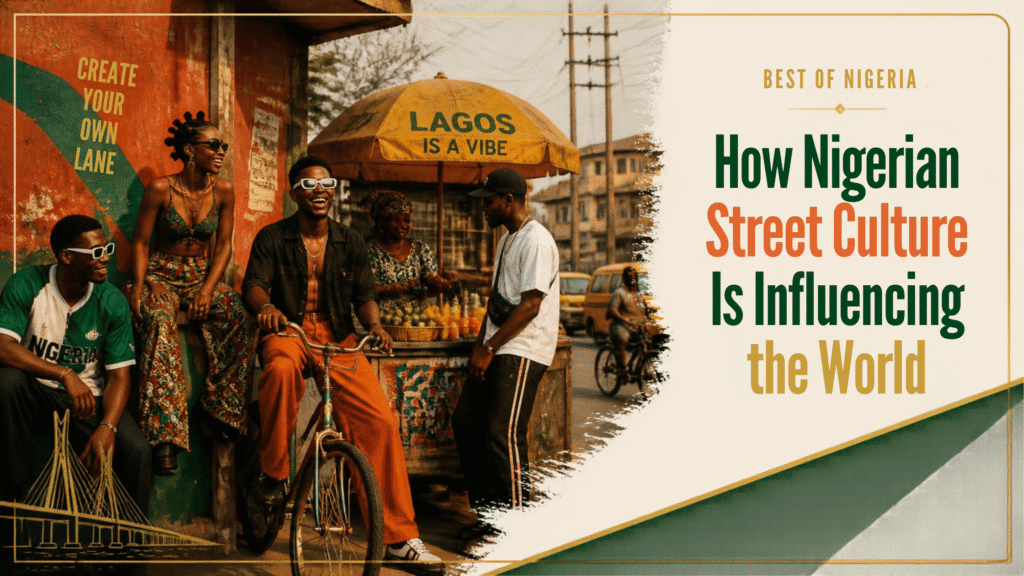
Nigerian street culture is no longer something the world encounters only when it visits Lagos.
It is showing up in music playlists in London, fashion conversations in Paris, dance videos on TikTok, Nigerian restaurants in New York, football jerseys styled as streetwear, global festivals, creative collaborations and the growing number of people who now use Nigerian expressions without necessarily having been to Nigeria.
What makes the movement interesting is that it did not begin in boardrooms.
It grew from the streets.
From Lagos bus stops and neighbourhood football pitches to Mainland parties, markets, barber shops, roadside food spots, underground music scenes and crowded clubs, Nigerian young people have spent decades turning everyday life into culture.
Today, parts of that culture are travelling far beyond Nigeria.
And the world is paying attention.
What Do We Mean by Nigerian Street Culture?
Street culture is bigger than streetwear.
In Nigeria, it can include music, fashion, slang, dance, food, nightlife, football, art, humour, photography, hairstyles, social-media behaviour and the way young people combine all of these things into an identity.
It is also difficult to separate Nigerian street culture from the country’s wider creative ecosystem.
A song can influence fashion. A fashion look can become part of a music video. A dance can spread through social media. A slang term can become a meme. A party can become a tourism experience. A local designer can dress an international artist.
The boundaries keep moving.
That interconnectedness is one reason Nigerian culture travels so well.
Lagos Is Becoming a Global Style Reference Point
For years, global fashion conversations tended to move in predictable directions: New York, London, Paris, Milan, Tokyo.
Lagos has increasingly entered that conversation.
Vogue’s coverage of Lagos Fashion Week has highlighted the city’s distinctive street style, including the way Lagosians combine international streetwear with locally made clothing, adire, aso-oke, traditional silhouettes and unexpected styling choices. The publication described the city’s street style as a mix of global references and local tailoring, with maximalist and gender-fluid looks increasingly visible.
That mix is important.
Nigerian street style does not have to choose between a vintage American sweatshirt and locally made trousers. Sneakers can sit beside agbada. A football jersey can be styled with jewellery. Traditional fabrics can appear in contemporary silhouettes.
The result is not simply “African fashion.”
It is Nigerian fashion responding to the world while remaining recognisably Nigerian.
Lagos Fashion Week has helped give this creativity an international platform. Its 2025 edition marked 15 years of the event, with more than 60 designers on the official schedule and about 15,000 guests attending across the five-day programme, according to Vogue.
Streetwear Is Becoming a Cultural Language
Nigerian streetwear has also moved beyond the idea of simply putting a logo on a T-shirt.
Young Nigerian designers are pulling references from football, music, local communities, markets, indigenous symbolism and everyday Lagos life.
That is significant because streetwear has historically been associated with cultural movements from places such as New York, Los Angeles and Tokyo.
African streetwear is increasingly developing its own references instead of simply importing them.
Recent writing on African streetwear has pointed to Lagos designers drawing from local sports culture, market aesthetics and religious iconography, including the transformation of football jerseys into fashion objects.
Nigeria’s music industry has accelerated this process.
When an artist wears a Nigerian designer in a music video viewed by audiences around the world, the clothing becomes part of the artist’s story. When fans imitate the look, street fashion becomes part of the music’s cultural footprint.
The relationship works both ways.
Fashion gives music a visual identity.
Music gives fashion an audience.
Afrobeats Took the Street With It
You cannot talk about Nigerian street culture going global without talking about music.
But the story is bigger than Afrobeats itself.
The global rise of Nigerian music has created an enormous distribution system for Nigerian visual culture.
Artists do not simply release songs. They release aesthetics.
Music videos introduce hairstyles, clothing, locations, slang, dance movements and attitudes to international audiences.
Spotify has documented how Afrobeats has increasingly influenced fashion and visual culture, highlighting artists such as Burna Boy, Tems and Asake and the way Nigerian cultural references appear in their styling and performances.
Odumodublvck’s use of the traditional Igbo okpu agu, for example, has become part of his visual identity. Asake has incorporated modern interpretations of Nigerian traditional clothing into his image. Burna Boy’s touring and fashion collaborations have also connected Nigerian creativity with international audiences.
This is one of the most important changes.
A Nigerian cultural reference no longer has to be translated for an international audience before it can travel.
Sometimes the audience simply sees it, likes it and adopts it.
The Nigerian Dance That Starts on the Street Can End Up Everywhere
Dance has always been central to Nigerian popular culture.
From Fuji and juju to contemporary Afrobeats, Nigerian music has rarely been separated from movement.
Today, social media has dramatically shortened the distance between a dance created in Nigeria and someone attempting it thousands of kilometres away.
A dance can begin at a party, appear in a music video, be recreated by Nigerian creators, enter TikTok and Instagram, and then be performed by people who have never visited Nigeria.
This creates a new form of cultural distribution.
The street is no longer limited by geography.
A phone camera can turn a Lagos dance floor into a global stage.
And Nigerian creators have become particularly skilled at making culture visual, participatory and easy to reproduce.
Nigerian Slang Is Travelling Too
Language may be one of the most underestimated parts of Nigerian cultural influence.
Words and expressions from Nigerian Pidgin, Yoruba, Igbo and other Nigerian languages increasingly appear in music, memes, captions and online conversations.
Expressions such as “wahala,” “no wahala,” “abeg” and “oya” have become recognisable far beyond their original everyday contexts, while Nigerian Pidgin continues to provide musicians and creators with a distinctive voice.
The influence is not always about individual words becoming part of another country’s everyday vocabulary.
Sometimes it is about rhythm.
The humour.
The exaggeration.
The way Nigerian internet culture turns ordinary situations into jokes, captions and memes.
That communication style has become part of the Nigerian digital personality.
The Internet Turned the Street Into a Media Platform
Traditional media once determined what could become internationally visible.
That has changed.
A teenager with a smartphone can now document a fashion look, dance, joke, food spot or neighbourhood moment and reach an international audience without waiting for a television station or magazine to notice.
This matters enormously for Nigerian street culture.
Much of it is spontaneous.
It happens at concerts, parties, universities, markets, football games, barbershops, restaurants and on the road.
Social media provides the distribution layer.
The result is a constant stream of Nigerian life being packaged, remixed and shared.
This is also why the Nigerian diaspora matters.
Nigerians living in London, Toronto, New York, Atlanta, Dubai and other cities constantly move ideas in both directions. Global trends come home, while Nigerian music, fashion, humour and language travel back out.
The result is a culture that is increasingly transnational.
Football Is Part of the Look
Football has always occupied a special place in Nigerian popular culture.
But the football shirt has increasingly moved beyond the pitch.
Jerseys have become fashion pieces, especially when styled with jeans, cargos, sneakers, jewellery or traditional Nigerian clothing.
This fits naturally into Nigerian street culture because sport, music and fashion already overlap.
The football pitch, the music concert and the street are not completely separate cultural spaces.
A jersey can be a statement about a club, a national identity, a favourite player or simply personal style.
That flexibility makes football fashion particularly easy to export.
Nigerian Food Is Becoming Part of the Experience
Street culture also travels through food.
Suya is perhaps the clearest example.
The smoky, spicy grilled meat associated strongly with northern Nigerian and Hausa culinary traditions has become one of the foods through which people outside Nigeria encounter Nigerian street food.
But the larger story goes beyond suya.
Nigerian restaurants and food businesses abroad are introducing dishes such as jollof rice, puff-puff, moi moi, pepper soup, egusi and other Nigerian foods to new audiences.
Food creates a different kind of cultural connection.
You may discover Nigerian music online.
But you can sit down in a restaurant and taste Nigeria.
That experience can lead to curiosity about the music, language, fashion and history behind the food.
Then There Is Lagos Nightlife
If Nigerian street culture has a physical headquarters, Lagos nightlife is one of its most visible rooms.
The city’s party culture has become part of the international image of contemporary Nigeria.
Detty December is the clearest example.
Every year, Nigerians living abroad return home alongside international visitors for a period packed with concerts, parties, restaurants, beach events, festivals and nightlife.
Channels Television, reporting from Lagos in December 2025, described the period as attracting Nigerians from the diaspora as well as tourists, with hotels, entertainment venues and other businesses preparing for the influx.
A 2026 report on the 2025 season estimated that about 3.6 million people participated in Lagos’s 55-day festive period and that consumer spending reached approximately ₦396.54 billion, although such figures are estimates rather than official national statistics.
More importantly, the cultural model itself is travelling.
The idea of returning home for an intense period of music, fashion, food, nightlife and community has become a recognisable part of the global Nigerian experience.
The Diaspora Is Extending the Street
Nigerian street culture does not stop at Nigeria’s borders.
It moves with Nigerians.
A Nigerian in Peckham can wear a Lagos-inspired outfit. A Nigerian-American DJ can play Afrobeats at a New York party. A Nigerian restaurant can introduce suya to a new neighbourhood. A diaspora creator can combine Nigerian slang with local internet culture.
The result is not a perfect copy of Lagos.
It becomes something new.
That is what makes cultural influence interesting: people take an idea from one place and reinterpret it somewhere else.
The diaspora effectively creates hundreds of smaller platforms for Nigerian culture around the world.
Global Brands Are Paying Attention
International companies are increasingly interested in Nigerian consumers and Nigerian cultural relevance.
Vogue reported that Adidas opened a flagship store in Lekki, Lagos, in December 2025, while other international brands including Swarovski, Patta, Montblanc and Tommy Hilfiger have expanded their presence or engagement with the Nigerian market.
That does not mean every international brand has successfully understood Nigerian culture.
In fact, the opposite lesson may be more useful.
Nigeria’s young consumers are highly exposed to global culture already. They know international brands. They see global trends.
What increasingly distinguishes culturally relevant brands is their ability to participate in local culture rather than simply advertise to Nigerians.
The direction of influence is therefore changing.
It is no longer simply:
Global brands → Nigerian consumers.
It is increasingly:
Nigerian culture ↔ global brands.
Nigerian Creatives Are Not Waiting for Permission
Perhaps the most important change is psychological.
For generations, cultural validation often seemed to come from outside.
A Nigerian designer needed international recognition.
A musician needed a Western collaboration.
A filmmaker needed foreign distribution.
A creative needed to be “discovered.”
The internet has weakened that gatekeeping system.
Nigerian creatives can build audiences directly.
They can sell directly.
They can collaborate across borders.
They can publish without asking permission.
They can create a visual language that makes sense in Lagos and still resonates in London, Johannesburg, New York or Dubai.
Lagos Fashion Week’s growth is one example of this infrastructure developing at home. International coverage of the event now treats Lagos not simply as a location where fashion happens, but as a source of ideas and aesthetics in its own right.
But Global Attention Does Not Automatically Mean Global Success
There is an important distinction between cultural visibility and economic power.
A Nigerian style can go viral without the designer making significant money from it.
A Nigerian song can become globally popular without every musician, producer or songwriter in its ecosystem benefiting equally.
A tourist boom can generate spending while also putting pressure on infrastructure and raising questions about who benefits.
That tension is already visible in conversations around Detty December. The Guardian reported concerns in 2026 about rising prices, infrastructure pressure and whether local communities benefit sufficiently from the seasonal influx.
The same question applies to fashion and creative work.
If Nigerian culture is influencing the world, the next challenge is making sure Nigerian creators, businesses and communities can capture more of the economic value created by that influence.
The Future May Be More Street Than Runway
The most interesting part of Nigerian cultural influence may not come from another major fashion show or another international music collaboration.
It may come from ordinary people.
The teenager styling a vintage football jersey with traditional trousers.
The barber creating a new look.
The DJ mixing Fuji with contemporary sounds.
The food vendor building a recognisable brand around a roadside favourite.
The designer turning discarded materials into new clothing.
The creator filming everyday Lagos life and posting it online.
The photographer documenting street style.
The young person in London mixing Nigerian identity with British street culture.
That is how culture actually spreads.
Not always from institutions downward.
Often from people outward.
Nigerian Street Culture Is Becoming an Export
Nigeria has spent years importing global culture and making it its own.
Now the exchange is moving in both directions.
Music, fashion, food, language, nightlife, football, humour and visual identity are travelling from Nigerian streets into global popular culture.
Some of the influence will be temporary. Some will be absorbed and transformed. Some will become permanent.
But the bigger story is already visible.
The world is not simply consuming Nigerian entertainment anymore.
It is increasingly engaging with Nigerian ways of dressing, speaking, celebrating, creating and expressing identity.
And that may be the real power of Nigerian street culture.
It does not need to look global to become global.
It only needs to remain unmistakably Nigerian.
