Aisha Alagbo and the Business of Traditional Herbal Wellness in Nigeria
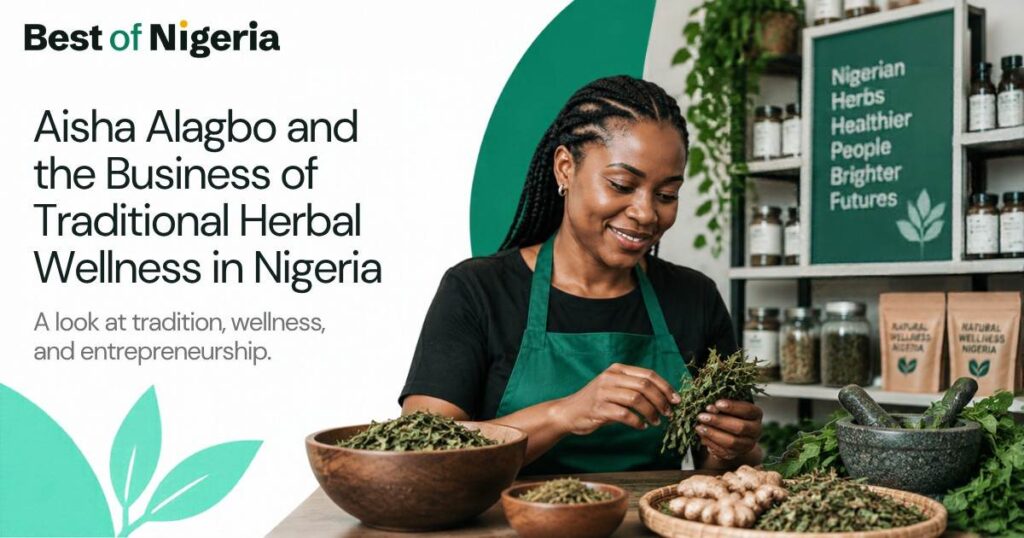
Nigeria’s traditional herbal medicine industry has existed for generations. Across communities, particularly in southwestern Nigeria, herbal practitioners have traditionally prepared and sold plant-based mixtures known as agbo, drawing on knowledge passed down through families and local communities.
For a long time, much of this trade operated through neighbourhood shops, open markets and roadside vendors. However, the industry is gradually taking on a different appearance as younger entrepreneurs introduce branding, product packaging, social media marketing and more structured business operations.
One personality attracting attention in this evolving space is Akanbi Aishat Oluwatoyin, popularly known as Aisha Alagbo.
Through her business, Aish Naturaleaf Herbal, she is building a presence around traditional herbal wellness, entrepreneurship and digital content creation. Her journey offers an interesting look at how indigenous knowledge and modern business strategies are coming together in Nigeria’s growing wellness market.
But beyond her social media recognition, there is a bigger business conversation worth exploring: how can traditional herbal knowledge become a structured, recognisable and sustainable Nigerian wellness industry?
Who Is Aisha Alagbo?
Aisha Alagbo, whose full name is Akanbi Aishat Oluwatoyin, is a Nigerian herbal wellness entrepreneur, content creator and founder of Aish Naturaleaf Herbal.
Her interest in traditional herbal practices developed from her exposure to herbal knowledge while growing up. According to published interviews, this early familiarity gradually developed into an interest in plant-based wellness and eventually became the foundation for her entrepreneurial journey.
Rather than limiting her activities to the traditional selling of herbal preparations, Aisha has embraced social media as a way of communicating with audiences, discussing wellness and building a recognisable business identity.
Her growing visibility reflects a wider development in Nigeria, where traditional practitioners and younger entrepreneurs are exploring digital platforms to reach customers beyond their immediate communities.
Aisha has also spoken about her desire to build a herbal wellness brand that is professional, accessible and trusted by consumers.
In interviews published in 2026, she has discussed the challenges of entrepreneurship, including managing a growing brand, dealing with public criticism and establishing consumer trust.
Her story is particularly interesting because it sits at the intersection of traditional knowledge, personal branding, digital entrepreneurship and Nigeria’s evolving wellness market.
Aish Naturaleaf Herbal: Building a Business Around Traditional Wellness
At the centre of Aisha Alagbo’s entrepreneurial activities is Aish Naturaleaf Herbal, a Nigerian herbal wellness brand.
The business focuses on plant-based wellness products and conversations around areas including reproductive and hormonal wellbeing.
According to Aisha’s public statements, her ambition extends beyond selling herbal products. She wants to build a brand that encourages people to understand wellness, learn about traditional practices and make informed choices.
This positioning is important in an industry where consumer trust can be a major challenge.
For years, many traditional herbal businesses have relied heavily on personal relationships, word-of-mouth recommendations and the reputation of individual practitioners.
Modern consumers, however, increasingly encounter brands through social media and online marketplaces. They want to know who is behind a product, what it contains, how it is prepared and whether the business can be trusted.
Aish Naturaleaf Herbal represents an attempt to bring a more recognisable brand identity to this market.
The opportunity is not simply to sell traditional herbal preparations but to build a business around education, communication, product development and customer relationships.
How Social Media Is Changing the Traditional Herbal Business
One of the most interesting aspects of Aisha Alagbo’s journey is her use of social media.
Platforms such as TikTok, Instagram and Facebook have changed how small businesses introduce products, communicate with customers and build brand recognition.
Traditional herbal businesses are increasingly participating in this shift.
Instead of depending entirely on physical locations and referrals, entrepreneurs can now introduce their products through videos, explain their business philosophies, share educational content and interact directly with potential customers.
Aisha’s digital presence demonstrates how an entrepreneur can combine content creation with product-based business development.
There are several important business lessons in this approach.
1. Personal Branding Can Build Business Recognition
People are often interested in knowing the personalities behind the businesses they patronise.
By sharing her interests, experiences and perspectives, Aisha has developed a public identity associated with her herbal wellness business.
This makes her more than a product seller. She becomes part of the brand’s communication and storytelling.
For entrepreneurs in traditional industries, personal branding can provide a way to introduce their businesses to audiences who might otherwise never encounter them.
2. Content Can Become a Customer Acquisition Channel
Social media content is not simply about entertainment or gaining followers.
For businesses, it can become a channel for attracting potential customers, answering questions, explaining products and generating enquiries.
A single well-received video can introduce a business to people across different Nigerian cities and even audiences outside the country.
However, visibility alone does not guarantee sales. Businesses still need reliable products, effective customer service and a clear purchasing process to convert attention into revenue.
3. Digital Platforms Can Help Traditional Businesses Reach New Markets
A herbal practitioner who previously depended on customers within one neighbourhood can now introduce a brand to a much wider audience.
This creates opportunities for online enquiries, digital customer relationships, structured distribution and potentially international expansion, subject to applicable regulatory requirements.
The same opportunity exists for businesses operating in other traditional industries, including food production, agriculture, fashion and indigenous crafts.
The Business Opportunity in Nigeria’s Traditional Herbal Wellness Industry
Nigeria has a long history of traditional medicine and the use of medicinal plants.
Across different communities, local knowledge has informed how people identify, prepare and use plants for various traditional purposes.
This knowledge represents an important part of the country’s cultural heritage.
It also presents opportunities for entrepreneurship, research, product development and the creation of businesses that can operate beyond informal local markets.
Several developments make the sector particularly interesting.
i. Growing Interest in Plant-Based Wellness
There is increasing interest among consumers in understanding ingredients, traditional practices and different approaches to personal wellbeing.
This creates opportunities for businesses that can communicate responsibly about plant-based products and provide transparent information.
However, consumer interest should not be confused with proof that a particular herbal product is safe or effective for treating a medical condition.
ii. Opportunities for Product Branding and Packaging
Traditional herbal products are often associated with informal packaging and inconsistent presentation.
There is an opportunity for responsible businesses to improve product identification, packaging, labelling, storage and distribution.
Professional presentation can make products easier to identify and help consumers understand what they are purchasing.
iii. Opportunities for Research and Product Development
Nigeria has a significant opportunity to develop its indigenous plant knowledge through scientific research, botanical documentation, standardisation and collaboration with research institutions.
The National Institute for Pharmaceutical Research and Development (NIPRD), for example, conducts research involving medicinal plants and traditional medicine.
This is an important area for the future of the industry because traditional knowledge needs to be documented and properly investigated if it is to support the development of credible wellness products.
iv. Opportunities for Distribution
A properly developed herbal wellness brand does not have to depend entirely on direct sales through social media.
Depending on product classification and regulatory approval, distribution opportunities may include:
- Retail pharmacies.
- Approved health and wellness stores.
- Supermarkets.
- Online retail platforms.
- Specialist distributors.
- Regional and international markets.
The ability to move from individual customer transactions to organised distribution could create opportunities for businesses in this sector to scale.
The Importance of Trust, Regulation and Product Safety
While the traditional herbal wellness industry presents business opportunities, it also comes with responsibilities.
Products intended for human consumption or medicinal use must be handled carefully. The fact that an ingredient is natural does not automatically make it safe.
Some herbal preparations can interact with prescription medications, cause adverse reactions or be unsuitable for particular individuals.
This is especially important when discussing reproductive health, fertility, pregnancy and hormonal conditions.
In Nigeria, the National Agency for Food and Drug Administration and Control (NAFDAC) provides regulatory requirements for herbal medicines and dietary supplements.
Its guidelines cover product registration, manufacturing requirements, labelling and other regulatory considerations.
Businesses operating in this space need to pay attention to several areas:
Product registration: Herbal medicines and related regulated products must comply with applicable NAFDAC registration requirements before manufacture, advertising, distribution or sale.
Ingredient transparency: Consumers should have access to clear information about product ingredients and other required labelling details.
Manufacturing standards: Proper production processes, hygiene, quality control and appropriate storage are important for product safety.
Responsible marketing: Businesses should avoid unsupported medical claims, misleading advertisements and promises of guaranteed cures.
Professional guidance: Herbal wellness businesses should recognise when customers need qualified medical assessment rather than relying on traditional preparations.
These requirements are not simply administrative obligations. They are important foundations for building consumer confidence and developing a sustainable industry.
For an entrepreneur seeking to build a long-term wellness brand, credibility must be treated as a business asset.
Challenges Facing Nigeria’s Traditional Herbal Wellness Businesses
Despite the opportunities, building a sustainable herbal wellness business in Nigeria is not without difficulties.
1. Consumer Trust
The industry has a mixed reputation, partly because of inconsistent product quality, exaggerated health claims and the presence of unregulated preparations.
Businesses that want to establish themselves professionally must demonstrate transparency and responsible practices.
2. Regulation and Compliance
Navigating product registration, manufacturing standards, labelling requirements and advertising regulations can be challenging, particularly for small businesses.
However, compliance becomes increasingly important as a business moves from small-scale operations towards wider distribution.
3. Scientific Research and Standardisation
Traditional knowledge can provide valuable starting points for research, but products intended to make medicinal claims require appropriate scientific assessment.
Consistency in ingredients, preparation methods, quality and dosage is also important.
4. Public Perception
Some consumers view traditional herbal practices with scepticism, while others may place too much confidence in products simply because they are described as natural.
Businesses need to communicate responsibly and avoid creating unrealistic expectations.
5. Scaling Beyond Social Media
Building an audience online is different from building a sustainable business.
As demand increases, businesses must develop reliable production, inventory management, customer service, fulfilment and distribution systems.
This transition from personal-brand-led sales to structured business operations can be one of the most important stages of growth.
What Other Nigerian Entrepreneurs Can Learn From Aisha Alagbo
Aisha Alagbo’s journey offers several lessons for entrepreneurs, particularly those operating in traditional or underserved industries.
i. You can build a modern business around traditional knowledge.
An industry does not have to abandon its cultural roots to become more professionally organised. Traditional knowledge can be documented, researched and developed into businesses that respect their origins.
ii. Personal branding can open business opportunities.
People can become interested in a business because of the person communicating its story. A recognisable founder can help give a brand a human identity.
iii. Content creation is a business development tool.
Social media can help businesses introduce products, educate audiences, generate enquiries and build relationships without relying entirely on conventional advertising.
iv. Professionalism matters as a business grows.
Packaging, product quality, compliance, customer service and operational systems become increasingly important when a business wants to reach larger markets.
v. Criticism can be part of building a public-facing brand.
Aisha has publicly acknowledged that dealing with criticism is one of the challenges of growing her business. Her position that consumers should ask questions about products they put into their bodies is particularly relevant to the wider wellness industry.
Entrepreneurs need to understand that trust is built through transparency, accountability and a willingness to improve.
The Future of Traditional Herbal Wellness in Nigeria
The future of Nigeria’s traditional herbal wellness industry will depend on more than the popularity of individual practitioners or viral social media personalities.
There is an opportunity to develop a more organised ecosystem involving traditional knowledge holders, researchers, manufacturers, regulatory institutions, distributors and technology businesses.
Digital platforms can help with customer education and market access. Research institutions can contribute to documenting and investigating indigenous plants. Manufacturers can develop consistent production processes, while distribution networks can connect compliant products with wider markets.
Entrepreneurs such as Aisha Alagbo are part of the evolving conversation about how traditional wellness practices can be presented and commercialised in a modern Nigerian economy.
Her ambition to build Aish Naturaleaf Herbal into a recognised wellness brand reflects a wider aspiration among local entrepreneurs: developing businesses rooted in Nigerian knowledge and identity that can compete beyond their immediate markets.
However, long-term success will require more than visibility. It will depend on product quality, regulatory compliance, credible information, consumer safety and sustainable business operations.
Final Thoughts
Aisha Alagbo’s entrepreneurial journey provides an interesting example of how traditional herbal wellness is finding a new expression in Nigeria.
Through Aish Naturaleaf Herbal, she is combining an interest in traditional practices with personal branding, social media and modern entrepreneurship.
Her story also highlights an opportunity that extends beyond one individual or business.
Nigeria has indigenous knowledge, plant resources and a history of traditional wellness practices that deserve proper documentation, research and responsible development.
The challenge is to build an industry where cultural heritage, entrepreneurship, scientific investigation and consumer protection can work together.
For aspiring entrepreneurs, the bigger lesson is that opportunities can exist in industries that have been around for generations. Sometimes, the opportunity lies in finding a better way to present, organise, develop and distribute what already exists.
The future of traditional herbal wellness in Nigeria may not be about choosing between tradition and modern business. It may be about developing a responsible model that brings the two together.

Best of Nigeria Editorial Team
The Best of Nigeria Editorial Team shares stories, insights, guides, and features celebrating Nigeria’s people, businesses, culture, destinations, and opportunities. Through informative articles and carefully curated content, we help readers discover the people, ideas, and organisations shaping Nigeria’s story.