10 Nigerian Festivals You Should Experience at Least Once
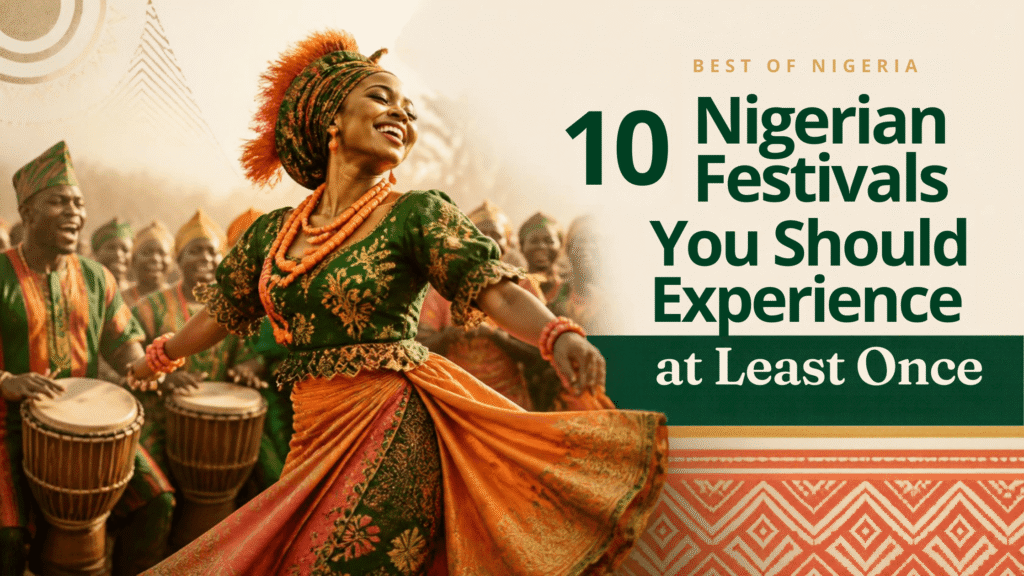
Nigeria has a way of turning culture into something you can see, hear, taste and feel.
Across the country, festivals bring together traditional institutions, music, dance, food, fashion, religion, history and community life. Some take place around ancient sacred sites. Others fill entire city streets with colour and music. Some are centred on royal ceremonies, while others celebrate harvests, fishing, masquerades or the legacy of cultural icons.
For travellers, festivals offer something that ordinary sightseeing cannot: a chance to encounter Nigerian culture in motion.
Nigeria’s festival calendar is enormous, with celebrations taking place across its six geopolitical zones throughout the year. Several Nigerian cultural traditions are also recognised by UNESCO, including the Sango Festival of Oyo, Argungu International Fishing and Cultural Festival, Durbar in Kano and the Ijele masquerade.
If you are looking for experiences that will give you a deeper understanding of Nigeria, these 10 festivals are excellent places to start.
1. Osun-Osogbo Festival, Osogbo, Osun State
Few Nigerian festivals combine spirituality, art, history and landscape quite like the Osun-Osogbo Festival.
Held annually in Osogbo, the festival centres on the Osun Sacred Grove, a UNESCO World Heritage Site associated with Osun, the Yoruba river goddess. The grove contains shrines, sculptures, artworks and sacred spaces connected to Yoruba cosmology.
The festival itself is not simply one afternoon of performances. UNESCO describes an annual processional festival lasting about 12 days, during which the community renews its relationship with Osun through rituals, processions and other traditional activities.
For a visitor, the experience can involve traditional processions, music, dancing, colourful clothing and the extraordinary setting of the sacred grove.
But there is an important distinction to make: this is a living religious and cultural tradition, not a performance created primarily for tourists.
When: Usually July/August, with the main festival traditionally taking place in August.
Why experience it: It offers an unusually direct encounter with Yoruba spirituality, art and living heritage.
2. Sango Festival, Oyo, Oyo State
If you want to understand the historical depth of Yoruba culture, the Sango Festival in Oyo deserves a place on your itinerary.
The festival commemorates Sango, the Yoruba deity associated with thunder and lightning, and is closely connected with the history and institutions of the old Oyo kingdom.
UNESCO inscribed the Sango Festival, Oyo, on the Representative List of the Intangible Cultural Heritage of Humanity in 2023. It describes the festival as a ten-day celebration held around the beginning of the Yoruba traditional New Year in August, involving chanting, storytelling, drumming, dancing, food, dress and ritual activities.
The festival takes place around the Koso Temple and involves different members of the Oyo community performing roles passed down between generations.
It is particularly interesting for visitors because it connects history, traditional religion, performance and community identity.
When: August.
Why experience it: It provides a window into the history and living traditions of the old Oyo kingdom.
3. Argungu International Fishing and Cultural Festival, Kebbi State
Imagine thousands of people gathering around a river while fishermen compete to catch fish using traditional techniques.
That is the basic idea behind one of northern Nigeria’s most distinctive festivals.
The Argungu International Fishing and Cultural Festival takes place in Kebbi State and combines the famous fishing competition with canoe races, wrestling, music, dance and other cultural activities. UNESCO lists the festival among Nigeria’s Intangible Cultural Heritage elements.
The 2026 edition, held from February 11 to 14, featured fishing and water competitions alongside cultural performances and other activities. The Federal Government described the festival as a long-running cultural celebration with roots stretching back to the 1930s as a major public event.
The festival is also a reminder that Nigerian cultural tourism extends far beyond Lagos and the southwest.
The landscapes, traditions and communities of northwestern Nigeria offer a very different festival experience.
When: Traditionally February, although dates should be confirmed for each edition.
Why experience it: The combination of fishing, river culture, competition and northern Nigerian traditions makes it unlike most other major Nigerian festivals.
4. Durbar, Kano and Northern Nigeria
Few Nigerian cultural spectacles are as visually striking as a Durbar.
Horsemen in elaborate traditional clothing ride in procession as part of celebrations associated with royal and religious occasions, particularly around Eid. The event connects contemporary celebrations with the history of emirate institutions and northern Nigerian horsemanship.
In 2024, Durbar in Kano was inscribed on UNESCO’s Representative List of the Intangible Cultural Heritage of Humanity.
The spectacle can include hundreds of horses, traditional regalia, drums and ceremonial displays.
But the horses and colourful clothing are only part of the story.
Durbar is also about traditional authority, community, history and the relationship between the emirate institution and the people.
The Kano State Government’s 2026 Sallah programme again highlighted the tradition of residents gathering to see their emirs on horseback during the festive period.
When: Usually around major Islamic celebrations such as Eid al-Fitr and Eid al-Adha, depending on the local calendar.
Why experience it: It is one of the clearest ways to see the ceremonial traditions and equestrian culture of northern Nigeria.
5. Ojude Oba, Ijebu-Ode, Ogun State
Every year, Ijebu-Ode becomes a spectacular meeting point for culture, fashion and community.
The Ojude Oba Festival takes place on the third day after Eid al-Kabir and brings together different Ijebu age-grade groups, known as regberegbe, who parade before the Awujale’s palace.
One of the most striking aspects of Ojude Oba is the fashion.
The festival has become famous for coordinated family and age-grade outfits, elaborate traditional clothing, horses, music and carefully choreographed appearances.
But beneath the photographs and fashion moments is a strong community structure.
The festival connects Ijebu people at home and in the diaspora with their traditional institution and with one another.
The 2026 edition was held on May 29 at the Awujale Palace in Ijebu-Ode.
For anyone interested in Nigerian fashion, heritage and community identity, Ojude Oba is particularly compelling.
When: The third day after Eid al-Kabir; the Gregorian date changes each year.
Why experience it: It brings together Yoruba heritage, traditional institutions, fashion, family identity and contemporary Nigerian culture.
6. Ofala Festival, Onitsha, Anambra State
In Onitsha, the Ofala Festival is the high point of the traditional ceremonial calendar.
It centres on the annual public emergence of the Obi of Onitsha after a period of seclusion and combines royal ceremony with music, dance, processions and displays of traditional identity.
The festival unfolds across two major ceremonial days. Iru Ofala focuses on the monarch’s appearances, while Azu Ofala features processions by age-grade societies and other cultural groups.
Modern Ofala has also expanded beyond the core royal ceremony. The programme now includes initiatives such as the Ofala Youth Carnival, Oreze International Art Exhibition and community health activities.
The 2026 edition is scheduled for October 16–17 at Ezechima Square in Onitsha and is themed “Igba Mbo, Iga N’Iru” “Strive and Advance”
If you want to see the relationship between traditional leadership, community organisations, fashion and modern cultural programming, Ofala is an excellent example.
When: Usually October.
Why experience it: It offers an immersive look at Igbo royal tradition and the way heritage can evolve without disappearing.
7. Carnival Calabar, Calabar, Cross River State
If the other festivals on this list lean heavily toward traditional heritage, Carnival Calabar brings a different kind of energy.
It is a massive celebration of costumes, music, dance, performance and street culture that turns Calabar into a festival city during the Christmas season.
The official 2026 programme includes weeks of cultural and entertainment events before the major parade. The main Carnival Calabar and Parade of Bands is scheduled for December 28, following the Cultural Carnival, Night of Kings and Queens and Junior Carnival.
The participating bands create elaborate costumes and performances around different themes, turning the carnival route into a moving theatrical production.
But Calabar Carnival is about more than one parade.
The wider festival calendar includes food events, concerts, exhibitions, cultural displays, sports and other activities.
The 2026 edition is themed “Rethinking Our Collective Destiny.”
When: December.
Why experience it: It is one of Nigeria’s biggest celebrations of contemporary street entertainment, costume, music and performance.
8. Felabration, Lagos
Not every Nigerian festival is built around an ancient ceremony.
Felabration celebrates the life, music and legacy of Fela Aníkúlápó-Kuti, the Nigerian musician whose Afrobeat became internationally influential.
Held in Lagos, the festival brings together music, performance, visual art, conversations and cultural programming.
The 2026 edition is scheduled for October 12–18, with programming around Fela’s legacy. Current 2026 programmes include music and cultural events at locations including the New Afrika Shrine and Freedom Park.
What makes Felabration particularly interesting is its connection between music and ideas.
Fela’s music was deeply associated with political and social commentary, so the festival has traditionally been about more than concerts. It has also provided a platform for conversations about society, culture, creativity and African identity.
For anyone interested in Nigerian music, Lagos nightlife and contemporary culture, it is one of the country’s most distinctive annual gatherings.
When: Usually October, around Fela’s birthday.
Why experience it: It connects Nigerian music history with contemporary performance, art and Lagos culture.
9. New Yam Festival, Southeast Nigeria
There is no single New Yam Festival that represents every community.
That is precisely what makes it interesting.
Known by names such as Iri Ji or Iwa Ji in different Igbo communities, the New Yam Festival is a major harvest celebration associated with the arrival of newly harvested yam.
Nigeria’s National Institute for Cultural Orientation describes it as a significant Igbo cultural event marking the end of the farming season and the beginning of a new harvest cycle, with rituals, feasting, music, dance and masquerades.
The precise date and format vary from community to community.
In some places, traditional leaders formally present or eat the first new yam before the wider community joins the celebration. Other communities add wrestling, masquerade performances, music, dancing, family reunions and other activities.
That variation is important.
Rather than thinking of the New Yam Festival as one centrally organised event, it is better understood as a family of related celebrations spread across Igbo communities.
When: Commonly August–October, depending on the community.
Why experience it: It connects food, agriculture, ancestry, community and Igbo cultural identity.
10. Eyo Festival, Lagos Island, Lagos State
Few Nigerian cultural images are as instantly recognisable as hundreds of white-clad Eyo masquerades moving through Lagos Island.
The Eyo Festival, also known as the Adamu Orisa Play, is deeply associated with the indigenous culture of Lagos Island.
According to Nigeria’s National Institute for Cultural Orientation, the Eyo masquerade emerges from the palace or ruling houses and appears in white flowing robes and distinctive hats. The festival can be held for significant traditional occasions, including the death of prominent traditional figures or the installation of a new Oba, meaning it does not operate on the same fixed annual calendar as festivals such as Calabar Carnival.
That is worth knowing before planning a trip.
Eyo is not simply an annual event with the same date every year.
In December 2025, Lagos staged the Adamu Orisa Play for the first time in eight years, according to the Lagos State Ministry of Tourism, Arts and Culture’s tourism platform.
The event brought thousands of Eyo masquerades onto the streets of Isale Eko.
For visitors fortunate enough to experience an edition, the combination of white costumes, traditional processions and Lagos Island’s historic environment is difficult to forget.
When: No fixed annual date; organised for specific traditional and civic occasions.
Why experience it: It is one of the strongest expressions of indigenous Lagos culture.
How to Experience Nigerian Festivals Respectfully
A festival is not a theme park.
Many Nigerian festivals have religious, spiritual, royal or community significance, so visitors should approach them with curiosity and respect.
A few simple principles can make the experience better:
Learn Before You Go
Understand what the festival represents before arriving. Knowing why a ritual, procession or costume matters will make the experience much richer.
Dress Appropriately
There may be specific expectations around clothing, especially at religious or traditional ceremonies.
Ask Before Photographing People
Some ceremonies, religious spaces and traditional figures may have restrictions around photography. When in doubt, ask.
Respect Restricted Areas
A festival may contain spaces intended only for traditional officials, worshippers, community members or participants.
Spend Locally
Use local accommodation, restaurants, transport providers, guides, artisans and vendors where practical. Cultural tourism can create opportunities for the communities hosting these events.
Give Yourself Time
Some festivals have programmes lasting several days or even weeks. Arriving for only the headline event can mean missing the parts that provide the most context.
Nigeria’s Festival Calendar Is a Journey Through the Country
One of the best things about exploring Nigerian festivals is that no single festival tells the whole Nigerian story.
Osun-Osogbo takes you into Yoruba spirituality and sacred art.
Sango connects you with the history of Oyo.
Argungu reveals the cultural world of northwestern Nigeria.
Durbar introduces the pageantry and equestrian traditions of the north.
Ojude Oba shows the power of community, fashion and identity.
Ofala brings Igbo royal tradition into the modern era.
New Yam celebrations connect food and agriculture with community.
Eyo reveals the indigenous heritage of Lagos Island.
And Calabar Carnival and Felabration show how Nigerian culture continues to evolve through music, entertainment and contemporary creativity.
That is perhaps the most important thing to understand about Nigerian festivals.
They are not all telling the same story.
They are thousands of stories, rituals, memories and traditions being kept alive by different communities.
And sometimes, the best way to understand Nigeria is not to read about those stories.
It is to show up and experience them.
