The Rise of Contemporary Nigerian Art
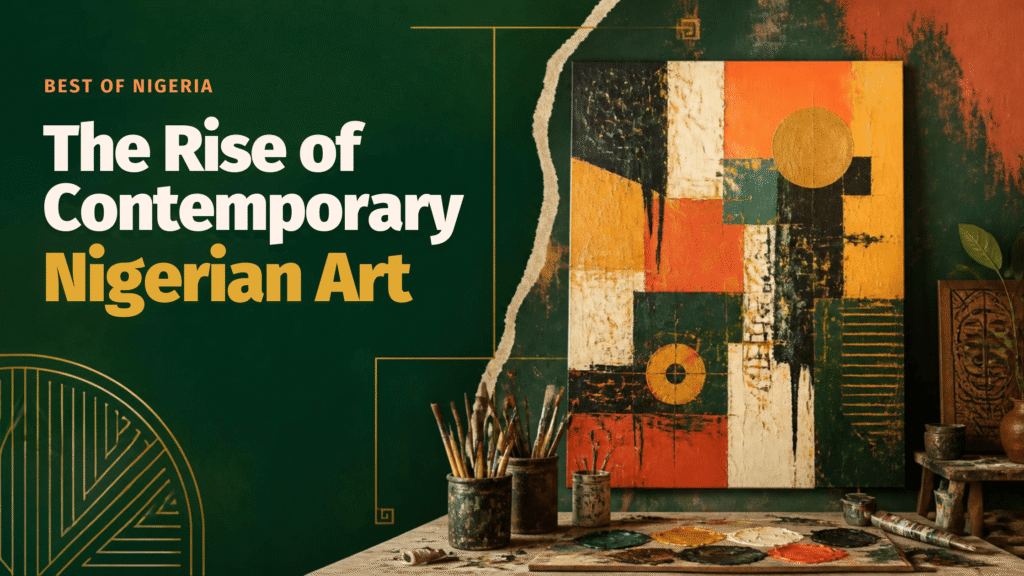
Walk into a contemporary art gallery in Lagos today and you may encounter oil paintings, photography, sculpture, textiles, installations, digital works, found objects or something that refuses to fit neatly into any category.
You may see an artist looking backwards at family photographs and inherited memories. Another may be thinking about Lagos traffic, migration, technology, gender, religion, politics or the environment. Someone else may be taking a traditional Nigerian technique and transforming it into something that feels completely new.
That variety is one of the defining characteristics of contemporary Nigerian art.
Nigeria has always had rich artistic traditions, from Nok sculpture and Yoruba woodcarving to Igbo uli designs, Benin bronzes, textile traditions and generations of modernist painters. But the contemporary Nigerian art scene has developed into something much broader: a network of artists, galleries, collectors, foundations, fairs, museums, residencies and independent spaces connecting Lagos and other Nigerian cities to audiences around the world.
Lagos sits at the centre of much of this activity. Over the past decade, the city has developed a growing gallery and fair infrastructure, while Nigerian artists have increasingly appeared in international exhibitions and collections. Art X Lagos, for example, reached its tenth edition in 2025 after attracting hundreds of thousands of visitors from around the world over its first decade.
The rise did not happen overnight.
It is the result of several generations of artists building on what came before them.
From Nigerian Modernism to Contemporary Practice
To understand contemporary Nigerian art, it helps to look at the generation that came before it.
Artists such as Ben Enwonwu, Uche Okeke, Yusuf Grillo, Bruce Onobrakpeya and Demas Nwoko helped establish important directions in Nigerian modern art.
They were working at a time when Nigeria was negotiating colonialism, independence and the question of what a modern Nigerian identity could look like.
Their work often engaged with Nigerian cultural traditions while also responding to modernist movements and international artistic ideas.
This created an important foundation for later generations.
The question was no longer simply whether Nigerian art could exist within a global art conversation.
Nigerian artists increasingly began to ask what they could contribute to that conversation on their own terms.
That legacy remains visible today. Newer galleries are still exhibiting modernist works alongside contemporary practices, while institutions and collectors continue to reassess the artists who helped establish Nigeria’s modern art history. Adegbola Gallery, for example, explicitly combines contemporary programming with a secondary-market focus on 20th-century Nigerian modernists.
Lagos Became the Centre of a New Art Ecosystem
If contemporary Nigerian art has a physical home, much of its infrastructure is concentrated in Lagos.
The city has developed a growing network of commercial galleries, artist-led spaces, foundations, fairs and cultural institutions.
Spaces such as Rele Gallery, Omenka Gallery, Kó Art Space, SMO Contemporary Art, Nike Art Gallery, Terra Kulture and Art Twenty One represent different parts of that ecosystem.
The important point is that there is no single Lagos art scene.
There are commercial galleries representing established and emerging artists. There are independent spaces experimenting with new exhibition formats. There are artist studios, residency programmes, cultural centres and temporary exhibitions.
Recent mapping of Lagos’s art infrastructure describes the scene as distributed across areas including Ikoyi, Victoria Island, Lekki and the mainland rather than concentrated in one traditional museum district.
That decentralisation has helped create a culture where artists can find different routes into the industry.
Art X Lagos Changed the Conversation
One of the most important developments in the growth of Nigeria’s contemporary art ecosystem has been Art X Lagos.
Founded by Tokini Peterside in 2016, the international art fair created a major meeting point for artists, galleries, collectors, curators and art audiences.
By its tenth edition in 2025, Art X Lagos had attracted more than 700,000 visitors from 170 countries and galleries from 70 nations, according to The Art Newspaper’s analysis of the fair’s first decade.
That scale matters.
An art fair does more than display paintings.
It creates opportunities for artists to meet collectors, galleries to develop international relationships and Nigerian art to be presented within a broader African and global market.
Art X has also helped make Lagos a destination for people interested in contemporary African art.
The result is an art ecosystem increasingly connected to international circuits rather than operating entirely within Nigeria.
Nigerian Artists Are Telling More Complicated Stories
One of the most interesting features of contemporary Nigerian art is the range of subjects artists are exploring.
Identity is a recurring theme, but identity itself is not simple.
Artists are exploring what it means to be Nigerian, African, Black, female, male, queer, religious, urban, rural, diasporic or part of multiple worlds at once.
Memory is another major theme.
Family photographs, childhood experiences, inherited objects, historical archives and stories passed between generations frequently appear in contemporary practices.
The past is not necessarily being reproduced exactly.
It is being questioned, reconstructed and sometimes deliberately disrupted.
Rele Gallery’s Young Contemporaries programme provides a useful example. Its 2026 edition featured artists exploring memory, healing and cultural inheritance, including work engaging with the history and labour of women in Balogun Market.
This is part of a broader shift.
Contemporary Nigerian artists are increasingly interested not just in what happened, but in who gets to remember it, who gets represented and what might have been left out.
Lagos Itself Has Become a Subject
You cannot separate contemporary Nigerian art from the cities in which much of it is produced.
Lagos is particularly influential.
The city’s density, traffic, architecture, wealth, inequality, nightlife, markets, waterways, construction and constant movement provide an enormous visual and conceptual archive.
For some artists, Lagos is a place of possibility.
For others, it is overwhelming.
For many, it is both.
The Lagos Biennial has deliberately embraced the city as part of its artistic framework. Founded by artists in 2017, the Biennial uses exhibitions, public programmes, research and residencies to explore complex social questions while placing Lagos itself at the centre of contemporary art production.
Its exhibitions have also used unusual architectural and urban sites rather than relying exclusively on conventional galleries.
That approach reflects something important about contemporary Nigerian art.
The artwork does not always exist independently of its environment.
Sometimes the city is part of the artwork.
Painting Is Still Powerful
With all the attention given to installations, photography, digital art and experimental practices, painting remains one of the strongest forms within contemporary Nigerian art.
Artists continue to use figurative painting to explore family, memory, social relationships, identity and everyday life.
But contemporary Nigerian painting is far removed from a single recognizable style.
Some artists use highly detailed realism.
Others work with abstraction, surrealism, distorted bodies, dreamlike environments or deliberately simplified forms.
The human figure remains particularly important.
Faces, bodies and domestic spaces can become ways of exploring questions that are much larger than the individual subject.
This is one reason Nigerian contemporary painting can be simultaneously personal and political without necessarily being explicitly political.
Photography Has Become Its Own Language
Photography has also become an important part of Nigeria’s contemporary art landscape.
Rather than treating photography simply as documentation, artists use staged photography, portraiture, archives and manipulated images to explore identity, history and representation.
Artists such as Yagazie Emezi have demonstrated how photography can examine culture, identity and social issues while operating within international contemporary art and editorial spaces.
Photography has also lowered some of the barriers between art, fashion, journalism and popular culture.
A photographer may work on an editorial campaign one month, an art project the next and a museum exhibition later.
The boundaries between creative disciplines are becoming increasingly porous.
Nigerian Artists Are Working Beyond the Canvas
One of the clearest signs of the contemporary era is the expansion of what counts as an artwork.
A contemporary Nigerian artist may work with:
- Painting
- Sculpture
- Photography
- Video
- Film
- Installation
- Performance
- Textiles
- Ceramics
- Digital art
- Found objects
- Architecture
- Sound
- Mixed media
The medium often follows the idea.
If a story is better communicated through an installation than a painting, the artist can build an installation.
If an archive needs to be reconstructed through photography, photography becomes the tool.
If a social issue requires public participation, the artwork can move outside the gallery entirely.
That flexibility has opened space for younger artists who may not identify with traditional categories.
Traditional Nigerian Culture Is Not Disappearing From Contemporary Art
Contemporary does not mean disconnected from tradition.
In fact, some of the most interesting Nigerian artists are doing the opposite.
They are looking backwards in order to move forward.
Traditional textiles, symbols, sculpture, hairstyles, architecture, folklore, religious imagery and indigenous histories can all become material for contemporary work.
The difference is that artists are not necessarily reproducing traditional forms exactly as they were.
They reinterpret them.
That can mean turning an old symbol into a large-scale installation, transforming textile techniques into contemporary sculpture or using archival material to question how Nigerian history has been represented.
The result is a relationship between heritage and experimentation rather than a choice between the two.
A New Generation Is Entering the Scene
One reason the Nigerian art scene continues to evolve is the emergence of programmes specifically designed to support younger artists.
Rele Arts Foundation’s Young Contemporaries programme is one example.
Its 2026 edition marked the 11th edition of the programme and provided a platform for three emerging artists who developed their practices through a residency in Ekiti State.
Other initiatives are also widening access.
The 2026 edition of +234 Art Fair, for example, was built around the theme “Inclusivity” and deliberately sought to bring greater visibility to artists working outside conventional networks and artists exploring different media.
This matters because the future of Nigerian art will depend not only on the artists who have already become internationally recognised, but also on whether new artists can find studios, mentorship, exhibitions, collectors and audiences.
The Diaspora Is Part of the Story
Contemporary Nigerian art does not stop at Nigeria’s borders.
Nigerian and Nigerian-descended artists working internationally have become important parts of the wider conversation.
Artists such as Njideka Akunyili Crosby, Toyin Ojih Odutola, Yinka Shonibare and Njideka Akunyili Crosby have built practices that engage with questions of Nigerian identity, migration, memory and cultural exchange from different geographical positions.
The relationship works in both directions.
Artists based abroad remain connected to Nigerian histories and audiences, while artists working in Lagos increasingly exhibit internationally.
The distinction between “Nigerian art” and “international art” therefore becomes less straightforward.
An artist can be Nigerian, Lagos-based, London-exhibited and globally collected at the same time.
That complexity is increasingly reflected in international art programming.
In 2026, RMB Latitudes’ Nigeria Focus brought more than 30 Nigerian artists working across painting, photography, textile and sculpture into a cross-continental programme beginning in Lagos and culminating at the Johannesburg art fair.
The Market Is Growing, But It Is Still Developing
The rise of Nigerian contemporary art is not only an artistic story.
It is also a market story.
Collectors, galleries, art fairs and international institutions have become increasingly interested in Nigerian artists.
But the growth is not without challenges.
Nigeria’s art market still has infrastructure gaps. Artists need sustainable studio support. Galleries need long-term collectors. Institutions need stronger funding. Museums need resources and audiences.
The Art Journal’s 2026 assessment of Lagos’s art market described the infrastructure as visibly stronger than it was a decade earlier while also questioning how durable that growth will be.
That distinction is important.
A growing number of exhibitions does not automatically create a sustainable ecosystem.
For contemporary Nigerian art to continue developing, artists need more than international attention.
They need systems that allow them to keep producing.
The Rise of Art Spaces Outside the Traditional Gallery
Another important development is the growing diversity of places where art can be encountered.
Contemporary art does not always happen inside a white-walled commercial gallery.
It can appear in cultural centres, hotels, offices, public spaces, independent project spaces, festivals, art fairs and temporary exhibitions.
Some organisations are deliberately taking art to audiences who may never walk into a conventional gallery.
That could prove especially important in Nigeria.
Art can sometimes feel inaccessible because of its language, pricing or environment.
The growth of alternative spaces creates opportunities for people to encounter contemporary art without already being part of the collector or gallery community.
Lagos Is Not the Whole Story
Lagos receives much of the international attention, but Nigerian contemporary art is not produced exclusively there.
Artists and creative communities exist across the country.
Abuja has an active arts and cultural scene. Enugu has a long artistic history. Benin City remains important to Nigerian art history and contemporary practice. Ibadan, Port Harcourt, Nsukka and other cities also contribute artists, institutions, schools and audiences.
This broader geography matters.
Nigeria’s artistic identity cannot be reduced to Lagos.
The country’s different histories, languages, environments and cultural traditions create multiple artistic perspectives.
The challenge is ensuring that these perspectives have the infrastructure and visibility required to participate in the national and international art conversation.
The Next Chapter May Be Even More Experimental
The contemporary Nigerian art scene is entering an interesting period.
Artists have more ways to distribute their work.
Galleries are increasingly connected internationally.
Art fairs provide access to collectors.
Social media allows artists to build audiences without waiting for institutional approval.
Residencies and mentorship programmes are creating pathways for younger practitioners.
And new technologies are opening possibilities in digital art, moving image and interactive work.
At the same time, artists continue to return to older questions: memory, identity, history, spirituality, community and place.
That combination may define the next stage of Nigerian art.
Technology does not necessarily mean abandoning tradition.
A digital artist can still be influenced by Yoruba cosmology.
A painter can use family archives.
A sculptor can reinterpret traditional forms.
A photographer can investigate colonial history.
A textile artist can combine ancient techniques with contemporary design.
The future is likely to be less about choosing between old and new and more about finding new relationships between them.
Why Contemporary Nigerian Art Matters
The rise of contemporary Nigerian art is significant because it changes how Nigeria is seen, but perhaps more importantly, it changes how Nigerians can see themselves.
Art gives people another way to examine history.
It allows artists to question inherited narratives.
It creates space for memories that may not appear in official archives.
It documents everyday life.
It challenges assumptions about Africa.
And it gives individual artists the freedom to say something that may be difficult to express through other forms.
The most exciting part of Nigerian contemporary art is therefore not simply that Nigerian artists are attracting international attention.
It is that the scene is becoming more diverse, more ambitious and more confident in defining its own questions.
The world is paying attention.
But Nigerian artists are not waiting for the world to tell them what their art should be.
They are already asking their own questions, about where they come from, where they live, what they remember and what kind of future they want to imagine.
That is where the real rise of contemporary Nigerian art is happening.
