Why Nigerian Culture Has Become a Global Influence
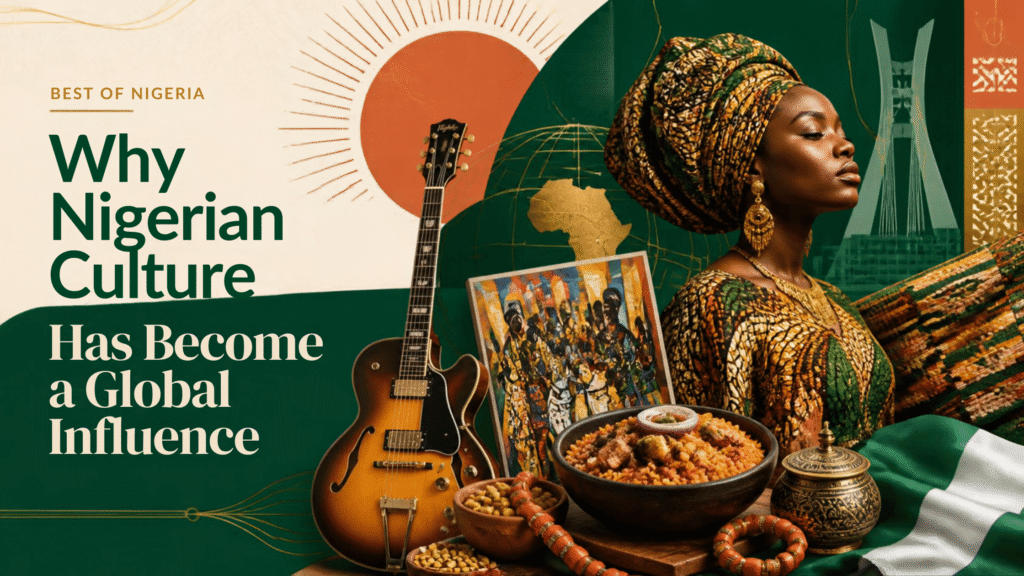
There was a time when Nigerian culture mostly travelled with Nigerians.
Today, it travels with everyone.
A Nigerian song can become a global hit. A Lagos designer can show collections internationally. Nigerian slang can appear in social-media conversations thousands of kilometres from Lagos. A traditional fabric can become part of a contemporary fashion collection. A Nigerian dish can introduce someone to a culture they have never experienced firsthand.
And increasingly, global brands, artists, designers and media organisations are looking towards Nigeria for ideas.
This did not happen overnight.
Nigeria has always had a deep cultural life. What has changed is the country’s ability to package, distribute and export that culture at scale.
Music helped open the door. Fashion followed. Film, food, art, nightlife, literature, sport, social media and the Nigerian diaspora have pushed it wider.
The result is a cultural influence that reaches well beyond the country’s borders.
Nigeria Has Always Had More Than One Culture
One reason Nigerian culture is so compelling is that there is no single Nigerian cultural experience.
Nigeria is home to hundreds of ethnic groups, languages, traditions and regional identities.
Yoruba, Igbo, Hausa, Ijaw, Efik, Ibibio, Edo, Tiv, Nupe, Kanuri and many other communities have their own histories, foods, music, clothing, festivals and artistic traditions.
Yet these cultures constantly interact.
Lagos can contain elements of Yoruba culture alongside Igbo entrepreneurship, northern Nigerian food traditions, global streetwear, American hip-hop, British fashion and internet culture.
A Nigerian artist can grow up listening to Fuji, hip-hop, highlife, gospel and American R&B and eventually create something that does not fit neatly into any one category.
That cultural mixing is not a weakness.
It is part of Nigeria’s creative advantage.
Music Became the Global Gateway
The strongest example is music.
Nigerian music has moved from being primarily consumed within Nigeria and its diaspora to becoming part of mainstream international popular culture.
Afrobeats has been central to that shift.
But the story did not begin with Afrobeats.
Nigeria has spent decades developing musical traditions including highlife, juju, Fuji, apala, Afrobeat, gospel, hip-hop and numerous regional sounds.
Those traditions created an enormous musical vocabulary for younger artists to draw from.
The result is a generation of Nigerian musicians who can combine local influences with global sounds without abandoning their Nigerian identity.
Artists such as Burna Boy, Wizkid, Davido, Tems, Rema and Ayra Starr have helped make Nigerian music increasingly visible to international audiences.
British Vogue’s 2026 profile of Tems, for example, describes her progression from Lagos’s music scene to international performances, Grammy recognition and collaborations with artists including Beyoncé, Drake and Justin Bieber.
That journey illustrates something larger.
Nigerian music is no longer simply being exported as “African music.”
Individual Nigerian artists are becoming global artists in their own right.
The Diaspora Became a Cultural Bridge
Nigeria’s diaspora has played a major role in this process.
Nigerians live, work, study and build communities across the United Kingdom, United States, Canada, Europe and other parts of the world.
They take culture with them.
They also bring global influences back home.
That creates a two-way exchange.
A Nigerian teenager in London might listen to Afrobeats, speak Nigerian Pidgin with friends, wear a Nigerian designer and follow Lagos nightlife online.
At the same time, a Lagos teenager may be influenced by British streetwear, American basketball culture or Korean pop culture.
The result is not simply Nigerian culture being preserved abroad.
It is constantly being recreated.
That is one reason Nigerian culture can feel familiar to members of the diaspora while continuing to evolve.
Nigerian Culture Is Highly Adaptable
Nigerian culture has never been static.
This may be one of its greatest strengths.
Traditional clothing can be redesigned as contemporary fashion.
Old musical rhythms can appear in modern production.
Indigenous languages can be used in pop songs.
Traditional stories can become films, artworks or fashion concepts.
Food can move from a family kitchen to a restaurant in another country.
This ability to adapt without completely abandoning the source is important in a globalised cultural environment.
Consider fashion.
Lagos Fashion Week has become a significant platform for Nigerian and African designers, reaching its 15th anniversary in 2025 with more than 60 designers and around 15,000 attendees. Vogue describes the event as an important platform for African creativity, cultural expression and fashion innovation.
The message is not simply that Nigerian designers can reproduce European fashion.
It is that Nigerian designers can contribute new ideas to the conversation.
Nigerian Fashion Is Turning Heritage Into Something Contemporary
The global interest in Nigerian fashion is particularly revealing.
Traditional Nigerian fabrics and techniques are increasingly being interpreted through contemporary silhouettes, tailoring and streetwear.
Aso-oke, adire, hand-dyed textiles, embroidery, weaving and indigenous references can appear alongside denim, sneakers, tailoring and modern accessories.
The important point is that the culture is not necessarily being preserved in a museum-like form.
It is being worn.
It is being redesigned.
It is being photographed.
It is being sold.
It is being passed to another generation.
Vogue’s coverage of Orange Culture’s 2026 Berlin collection, for example, describes how Nigerian designer Adebayo Oke-Lawal drew on memories of Nigerian family life while producing the collection in Nigeria with locally sourced fabrics and Lagos-based artisans.
That is cultural influence in practice: local stories becoming material for international creative work.
Nigerian Artists Are Changing How Nigeria Is Seen
For decades, much international coverage of Nigeria focused heavily on politics, poverty, corruption or economic challenges.
Those realities are part of the country.
But they are not the whole country.
Artists, designers, musicians, filmmakers, photographers and writers have helped introduce different images of Nigeria to global audiences.
The Lagos they show can be energetic, fashionable, complicated, ambitious, humorous and creative.
It can also be imperfect.
That complexity matters.
Culture allows people to encounter a country through human experiences rather than statistics alone.
A painting can communicate memory.
A film can communicate family.
A song can communicate ambition.
A photograph can communicate a city.
A fashion collection can communicate heritage.
Lagos Has Become a Cultural Reference Point
Lagos occupies a special position in this story.
It is not the entirety of Nigerian culture, but it has become one of its most visible global gateways.
The city brings together music, fashion, nightlife, technology, food, art, media and entrepreneurship in a way that creates constant cultural cross-pollination.
International attention to Lagos has grown alongside this creative activity.
Vogue previously described Lagos as a major cultural reference point, highlighting the city’s influence across music, art, sport, fashion and nightlife.
More recently, global brands have increasingly established a physical presence in Lagos.
Adidas opened a flagship store in Lekki in December 2025, while brands including Swarovski, Patta, Montblanc and Tommy Hilfiger have also expanded their presence or engagement in Nigeria, according to Vogue.
The significance is not simply that international brands are entering Nigeria.
It is that they increasingly have to understand the culture of the market they want to participate in.
Social Media Changed the Distribution Model
Perhaps the biggest difference between Nigerian culture today and Nigerian culture 30 years ago is distribution.
The internet removed many of the old gatekeepers.
A Nigerian creator no longer needs a major international media company to introduce their work to the world.
A TikTok video can travel internationally within hours.
A song can be streamed in dozens of countries.
A fashion designer can show a collection online.
A Nigerian restaurant can attract customers through Instagram.
A photographer can build an audience without a traditional magazine.
This matters because Nigerian culture is highly visual and highly social.
People do not just consume it.
They participate in it.
They dance.
They recreate outfits.
They use the slang.
They cook the food.
They make memes.
They remix songs.
They share videos.
Culture becomes easier to export when people can participate in it rather than simply watch it.
Nigerian Humour Is Part of the Influence
One of the less obvious Nigerian exports is humour.
Nigerian comedy and internet culture have developed a distinctive style built around exaggeration, timing, wordplay, facial expressions, social observation and the ability to turn everyday situations into entertainment.
Social media has allowed that style to travel.
Nigerian creators can take something completely ordinary—a family conversation, a relationship problem, a business interaction, a bus ride—and turn it into content that audiences outside Nigeria can understand even when some of the cultural details are unfamiliar.
Humour creates an unusually effective bridge.
People may not know the history behind a particular Nigerian tradition.
But they can understand a joke.
And once they become curious about the joke, they may become curious about the culture behind it.
Nigerian Food Is Becoming Cultural Diplomacy
Food is another powerful entry point.
Jollof rice is probably the most internationally recognisable Nigerian food conversation, but the country’s cuisine goes much further.
Suya, egusi, pounded yam, moi moi, akara, pepper soup, nkwobi, afang, edikang ikong, banga and countless regional dishes provide different ways into Nigerian culture.
Food carries geography and history.
It can tell you about agriculture, trade, migration, religion, family traditions and regional identity.
As Nigerian restaurants and food businesses expand internationally, these dishes become cultural ambassadors.
Someone may encounter Nigeria through a plate of suya before ever listening to an Afrobeats album.
Another person may discover Nigerian culture through jollof before becoming interested in Nigerian fashion.
Culture rarely travels in a straight line.
One doorway leads to another.
Nigerian Culture Has a Strong Sense of Identity
Globalisation can sometimes make cultures look increasingly similar.
The same brands appear everywhere.
The same social platforms dominate.
The same trends move between cities.
Nigerian culture has responded differently.
Young Nigerians frequently absorb global influences while still insisting on local identity.
That might mean singing in Yoruba on a globally successful record.
It might mean wearing traditional Nigerian clothing with sneakers.
It might mean using Nigerian slang in an international interview.
It might mean building a fashion brand around Nigerian textiles rather than hiding them.
This balance between global relevance and local identity has become one of Nigeria’s most recognisable cultural characteristics.
Global Brands Have Started Following the Culture
The relationship between Nigerian culture and global brands is increasingly visible.
Music is one of the clearest examples.
International fashion houses have worked with Nigerian artists, while Nigerian musicians increasingly appear at major international fashion events and campaigns.
Vogue has documented collaborations involving Burna Boy, Ayra Starr, Tems and other African artists with major fashion houses and luxury brands.
This reflects a wider shift.
Global companies increasingly understand that cultural relevance can be more valuable than simply buying advertising.
If a brand wants to speak to young consumers, it may need to understand the musicians they listen to, the designers they wear, the events they attend and the communities they identify with.
Nigeria has become an important part of that conversation.
Nigerian Culture Is Also Influencing Other African Markets
There is another part of the story that can easily be missed.
Nigerian influence is not only about Nigeria versus the Western world.
Nigeria also has a major cultural relationship with the rest of Africa.
Nigerian music travels across the continent.
Nigerian films have long reached African audiences.
Nigerian fashion influences regional style.
Nigerian television, comedy and social-media creators have audiences across African markets.
At the same time, Nigerian creatives are influenced by Ghanaian, South African, Senegalese, Kenyan and other African cultures.
So the movement is not one-way.
African culture is increasingly interacting across borders, and Nigeria is one of the largest contributors to that exchange.
The World Is Beginning to See Nigeria Through More Than One Lens
Perhaps the most important change is not that Nigerian culture has suddenly become influential.
It is that the world has more opportunities to encounter it.
A country with more than 200 million people has always generated enormous cultural output.
The difference is that modern distribution systems can now carry that output much further.
Streaming platforms can distribute music.
Social media can distribute humour and fashion.
Global festivals can distribute art.
Diaspora communities can distribute language and food.
International fashion weeks can distribute design.
Tourism can distribute experiences.
Digital commerce can distribute products.
The culture already existed.
The infrastructure for exporting it has improved.
Cultural Influence Creates a Bigger Question
Global attention is valuable, but visibility alone is not enough.
The long-term question is whether Nigerian creators and businesses can capture more of the economic value generated by the culture.
If a Nigerian design becomes globally popular, who owns the brand?
If a sound becomes internationally successful, who owns the rights?
If Nigerian food becomes fashionable abroad, who operates the restaurants and food businesses?
If Nigerian aesthetics influence international fashion, which Nigerian designers benefit?
These questions matter because cultural influence can exist without equal economic power.
The opportunity is to move from simply being culturally influential to building stronger industries around that influence.
Nigeria’s Cultural Influence Is Still Evolving
There is no single moment when Nigerian culture “became” global.
It has been a long process.
Highlife and juju created earlier international connections.
Nollywood introduced Nigerian storytelling to huge audiences.
Afrobeat gave Nigerian political and musical ideas an international vocabulary.
Afrobeats created a new generation of global music stars.
Fashion designers translated Nigerian heritage into contemporary design.
Social media gave ordinary Nigerians direct distribution.
The diaspora carried culture into new cities.
And global brands increasingly recognised that Nigeria is not simply a market to sell to.
It is a source of culture.
Nigeria’s Biggest Cultural Export May Be Its Ability to Create
The most interesting thing about Nigerian culture is not any single song, designer, dish, film or festival.
It is the constant ability to create something new from what already exists.
Old becomes new.
Local becomes global.
Traditional becomes contemporary.
Foreign influences become Nigerian.
And Nigerian ideas travel outward and get transformed somewhere else.
That cycle has been happening for generations.
Technology has simply made the cycle faster.
Nigeria’s cultural influence is therefore not just about what the rest of the world is consuming.
It is about what Nigerian people continue to make.
And if the country’s creative industries can build stronger businesses, institutions and distribution networks around that creativity, the next chapter may be bigger than cultural recognition.
It could be cultural power with economic weight behind it.
