The Nigerian Foods That Tell the Story of Our Different Regions
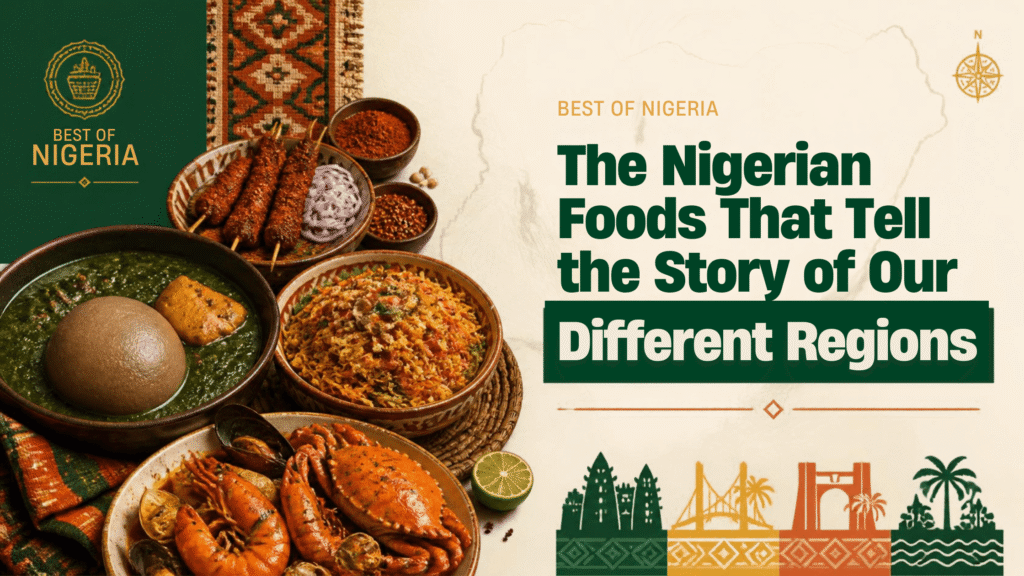
One of the easiest ways to understand Nigeria is to eat your way across it.
The country’s food changes as dramatically as its landscape. Move from the savannahs of the North to the forests of the South, from the Yoruba heartlands of the Southwest to the riverine communities of the Niger Delta, and you encounter different crops, ingredients, cooking techniques and food traditions.
Rice, yam, cassava, plantain, beans, palm fruit, leafy vegetables, seafood, grains and spices appear again and again, but they are transformed differently from one community to another.
That is what makes Nigerian cuisine so interesting.
A dish is rarely just a dish. It can tell you something about the crops a community grows, the environment around it, the history of its people, the ingredients available to households and even the occasions on which food is prepared.
Nigeria’s intangible cultural heritage framework itself recognises culinary skills alongside music, folklore, arts, crafts, costumes and other expressions of cultural life.
Here are 10 Nigerian foods that help tell that story.
1. Tuwo Shinkafa, The Rice Culture of Northern Nigeria
In Northern Nigeria, rice takes on a form that may be unfamiliar to someone whose experience of Nigerian rice begins and ends with jollof.
Tuwo shinkafa is made from soft, cooked rice that is mashed or processed into a smooth, firm consistency and shaped into portions. It is traditionally eaten with soups and stews, particularly across northern communities.
One of its classic companions is miyan kuka, a soup made with dried and ground baobab leaves.
The combination is a useful introduction to northern Nigerian food because it shows how different the region’s culinary traditions can be from the better-known food culture of the South.
Miyan kuka has an earthy, distinctive flavour, while tuwo provides the soft, mild base needed to carry the soup.
The meal also reflects the importance of grains and hardy plants in northern food traditions.
In other words, this is not simply rice prepared differently.
It is rice adapted into a food culture of its own.
2. Miyan Kuka, Food Shaped by the Savanna
Miyan kuka deserves a second look because its main ingredient tells part of the environmental story of northern Nigeria.
The soup is made from powdered dried baobab leaves, traditionally combined with ingredients such as dried fish, onions, peppers and seasonings. It is commonly served with tuwo shinkafa.
The baobab itself is an important African tree, and its leaves provide an ingredient that can be dried and stored.
That matters in a region where food traditions have historically developed around available crops, livestock, grains and ingredients that can withstand seasonal changes.
Miyan kuka is therefore a good reminder that Nigerian food is not only about what tastes good.
It is also about what grows where people live and how generations of cooks learn to turn those ingredients into something satisfying.
3. Amala and Ewedu, A Taste of Yoruba Food Culture
Few combinations are more immediately associated with Yoruba food culture than amala and ewedu.
Amala is made from processed yam flour or other starchy ingredients depending on the variety, producing the dark, soft swallow familiar across southwestern Nigeria.
Ewedu, meanwhile, is a smooth green soup made from jute leaves. It is often paired with gbegiri, a bean-based soup, and a rich stew, creating the combination popularly served as amala and ewedu.
The meal tells a story about the importance of swallows and soups in southwestern Nigerian food culture.
It also demonstrates how one meal can combine several textures and flavours: the soft, earthy amala, slippery ewedu, beans in gbegiri and the peppery richness of stew.
The broader Yoruba cultural landscape has deep traditions of food, agriculture and communal celebration. UNESCO’s intangible cultural heritage records, for example, include the Sango Festival of Oyo, reflecting the wider cultural heritage of the Yoruba region.
Food sits naturally within that larger cultural story.
4. Pounded Yam, The Yam Story of Southern Nigeria
If amala tells one part of the Southwest’s food story, pounded yam tells another.
Known as iyan in Yoruba, pounded yam is made by boiling yam and pounding it until it becomes smooth, stretchy and dough-like. It is commonly eaten with richly flavoured soups.
Yam has a long history in West African agriculture and food culture, and pounded yam developed as a way of turning the tuber into a soft accompaniment for soups and stews.
The physical preparation is part of the tradition.
Traditionally, pounding involves a mortar and pestle, requiring rhythm, strength and coordination. Modern kitchens can make the process easier, but the characteristic texture remains the defining feature.
Across Nigeria’s yam-growing regions, pounded yam can appear at everyday meals, family gatherings and celebrations.
It therefore connects agriculture, labour, food preparation and hospitality in one dish.
5. Nkwobi, The Igbo Love of Rich, Spicy Food
Travel southeast and the food story changes again.
Nkwobi, strongly associated with Igbo cuisine, is traditionally made from cow’s foot cooked until tender and mixed with a thick, spicy palm-oil-based sauce.
It is not usually presented as a giant bowl of family dinner food.
Nkwobi is often enjoyed in social settings and restaurants, where the dish is ordered and shared.
The texture is central to the experience. Long cooking makes the cow’s foot soft and gelatinous, while the sauce brings heat, palm-oil richness and seasoning.
It is a dish that makes use of parts of an animal that might otherwise be discarded, turning them into something highly sought after.
That is an important characteristic of traditional food systems everywhere: cooks learn to make the most of what is available.
6. Ofe Akwu and Banga, The Palm-Fruit Story
Palm fruit is one of the most important ingredients in many southern Nigerian food traditions, particularly in areas where oil palms thrive.
Two dishes that demonstrate this are ofe akwu and banga soup.
Ofe akwu is associated particularly with eastern Nigeria and is commonly made from palm fruit extract, with variations incorporating meat, fish and other seasonings.
Banga soup uses palm fruit as its foundation too, but the dish takes on different identities across southern communities. In the Niger Delta, for example, related preparations have different names and are paired with different foods. TasteAtlas notes that the Urhobo call one version oghwo amiedi, while other communities have their own variations and names.
That variation is important.
There is no single “palm-fruit soup” that represents the entire South.
Instead, the same broad ingredient becomes part of different culinary traditions.
The palm tree connects them, but the communities give the ingredient their own identity.
7. Edikaikong, The Rich Vegetable Tradition of the South-South
Edikaikong takes us further into the food traditions of southeastern and South-South Nigeria.
The soup is particularly associated with the Efik people and the Cross River and Akwa Ibom region.
It is a vegetable-rich dish traditionally prepared with ingredients including ugu, waterleaf, palm oil, crayfish, fish and assorted meat or seafood. Recipes vary depending on the household and availability of ingredients.
The result is thick, deeply savoury and packed with different textures.
Edikaikong also demonstrates something important about southern Nigerian food: vegetables are not necessarily treated as a side dish.
They can form the heart of a substantial meal.
The soup is commonly served with eba, pounded yam or another swallow.
It is food that reflects both the abundance of leafy vegetables in the region and the long culinary tradition of combining vegetables with seafood, meat and palm oil.
8. Afang Soup, Forest, Leaves and Seafood
Another dish that takes us into the food traditions of the Cross River and Akwa Ibom region is afang soup.
The dish gets its name from afang leaves and is commonly prepared with other vegetables, palm oil, meat, fish or seafood and seasonings.
The result is a soup with a distinctly leafy, savoury character.
Afang belongs to the same broader family of Nigerian vegetable-rich soups, but its particular ingredients and preparation give it a regional identity.
It is commonly eaten with swallows, making the meal less about a single standalone soup and more about the relationship between soup, starch and whatever protein is available.
That relationship is repeated throughout Nigerian cuisine.
The swallow is the base.
The soup carries the character.
The combination becomes the meal.
9. Suya,Where Northern Food Became Nigerian Street Food
Some foods begin with strong regional associations and eventually become national.
Suya is one of the clearest examples.
The spicy grilled meat is strongly associated with Hausa food culture and northern Nigeria, but it has become a familiar part of street life across the country.
Thinly sliced meat is coated in a spicy seasoning commonly known as yaji and grilled over charcoal.
The result is smoky, spicy and intensely savoury.
Today, you can find suya spots from Lagos to Abuja and beyond. TasteAtlas lists suya among Nigeria’s key traditional foods and identifies it as a major Nigerian street-food experience.
Its journey from regional tradition to national street food tells an interesting story about Nigeria itself.
People move.
Cities grow.
Markets connect communities.
And food travels with them.
A food can retain its roots while becoming something enjoyed by people far beyond the community where it became famous.
10. Seafood Pepper Soup, The Riverine Nigeria on a Plate
In the riverine communities of southern Nigeria, particularly across the Niger Delta, water shapes everyday life — and naturally influences food.
Fish and seafood feature prominently in many local food traditions.
One expression of that is fish pepper soup, often prepared with fresh fish, peppers, onions, herbs and aromatic spices.
The exact recipe varies widely, but the underlying idea is simple: fresh fish becomes the centre of a hot, intensely seasoned broth.
In some restaurants, customers can even select a live catfish before it is prepared, the practice that gives rise to the expression “point and kill.”
This style of food reflects a very different environment from the grain-focused food traditions of the North.
Where northern food often draws heavily on grains, dried ingredients and livestock, riverine cooking naturally makes greater use of fish and aquatic resources.
The geography ends up on the plate.
One Country, Many Food Stories
The most interesting thing about Nigerian cuisine is that the boundaries are never completely neat.
A dish associated with one ethnic group may be eaten far beyond that community.
An ingredient can appear in different forms across several states.
A meal that was once strongly regional can become national through migration, urbanisation, restaurants and street food.
Suya is a perfect example.
Palm-fruit soups provide another.
Pounded yam has travelled far beyond the places where yam cultivation has historically been central.
That is why it can be misleading to divide Nigerian food too rigidly into “Northern food” and “Southern food”.
The categories help us understand broad patterns, but Nigerian cuisine is ultimately a network of overlapping food traditions.
Food Also Preserves Culture
Nigeria’s cultural heritage is not preserved only in museums.
It lives in kitchens.
It lives in the knowledge of which leaves to use, how long to cook a particular meat, how to pound yam until the texture is right, how to prepare a soup for a wedding, and which dish should be served when visitors arrive.
UNESCO’s inventory of Nigeria’s intangible cultural heritage includes traditions such as the Ijele masquerade, Gelede, Ifa, Kwagh-Hir, the Argungu International Fishing and Cultural Festival, Sango Festival and Durbar in Kano.
These traditions exist alongside everyday practices such as cooking, farming, eating and passing recipes from one generation to another.
Food is therefore part of the cultural infrastructure that holds communities together.
And as Nigerians move between cities and countries, those food traditions travel too.
A plate of amala in Lagos can carry memories of Ibadan.
A bowl of banga can connect someone in Abuja to the Delta.
A plate of tuwo can remind someone living abroad of home.
A bag of yaji can make a Nigerian abroad remember the smell of a roadside suya stand.
That is the power of food.
The Nigeria You Can Taste
If you want to understand Nigeria beyond its headlines, start with its food.
Try tuwo shinkafa and miyan kuka.
Try amala and ewedu.
Try pounded yam with a rich soup.
Try nkwobi.
Try banga or ofe akwu.
Try edikaikong and afang.
Try suya.
Try fish pepper soup.
And do not stop at the most famous dishes.
Ask where a meal comes from.
Ask who traditionally prepares it.
Ask what grows in that part of the country.
Ask why a particular ingredient is used.
Because the answers often lead somewhere much more interesting than the plate.
They lead into Nigeria’s geography, history, agriculture, migration, language and identity.
The country’s regions may have different food traditions, but together they tell one much larger story:
Nigeria is not one cuisine. It is many food cultures sharing one country.
