15 Nigerian Foods You Need to Know Beyond Jollof Rice
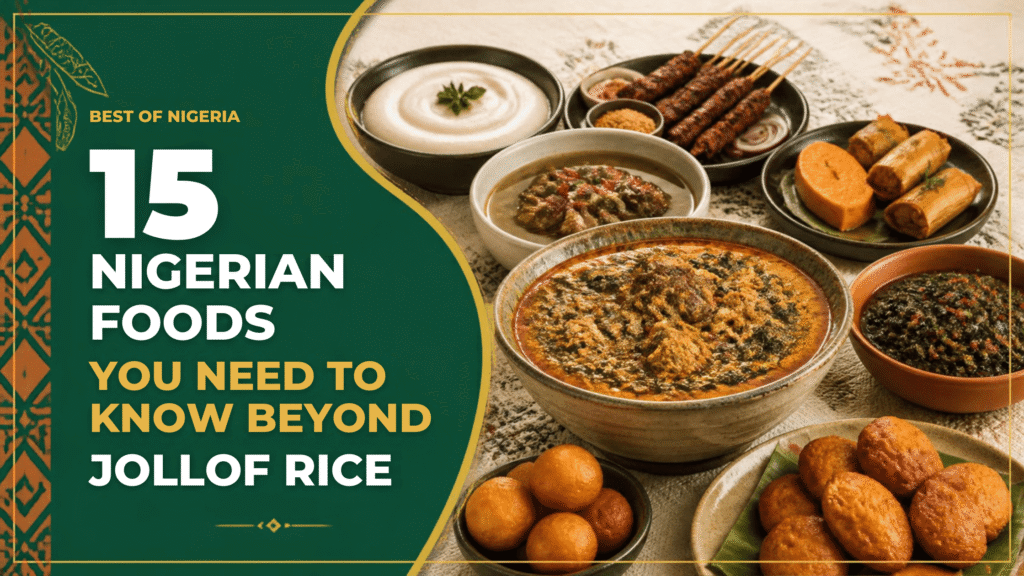
Jollof rice may be Nigeria’s most internationally recognisable dish, but it is only the beginning.
Nigerian food is far too diverse to fit around one pot of rice.
Across the country, food reflects geography, agriculture, ethnicity, migration, religion, family traditions and the ingredients available in different communities. Yam, cassava, plantain, beans, leafy vegetables, palm fruit, peppers, seafood and grains all play major roles, but the ways they are prepared can change dramatically from one part of Nigeria to another.
That diversity is part of what makes Nigerian cuisine so interesting.
A meal in Lagos can look very different from one in Kano, Enugu, Calabar, Ibadan or Benin City. Some dishes are everyday staples. Others are associated with celebrations. Some are eaten from roadside stalls, while others arrive at the table in homes and restaurants as elaborate soups and stews.
And then there are the foods that Nigerians argue about endlessly — how spicy they should be, what they should be eaten with, which region makes them best and whether the correct way to eat them requires a spoon or your hands.
So, if your knowledge of Nigerian food begins and ends with jollof rice, here are 15 dishes worth knowing.
1. Suya
If jollof is one of Nigeria’s great party foods, suya is one of its great street foods.
Thin slices of beef, chicken or other meat are coated in a spicy seasoning commonly known as yaji and grilled over charcoal. The result is smoky, spicy and intensely savoury.
Suya is strongly associated with Hausa culinary traditions and is now eaten across Nigeria. TasteAtlas describes it as a popular Nigerian street food made from seasoned meat roasted over charcoal, with yaji providing its characteristic flavour.
A typical serving might come with sliced onions, tomatoes and extra pepper.
But the real experience is standing beside a suya spot in the evening, watching the meat being sliced, seasoned and grilled while the smoke carries the smell down the street.
Suya is more than something to eat on the way home.
It is part of Nigerian nightlife.
2. Pounded Yam and Soup
Few Nigerian meals communicate the importance of texture quite like pounded yam.
Boiled yam is pounded until it becomes smooth, stretchy and soft, producing the classic white mound of iyan served alongside soups such as egusi, efo riro, ogbono or vegetable soups.
The dish has deep connections to yam cultivation in West Africa, where yam has long been an important crop.
Traditionally, pounded yam is prepared with a mortar and pestle, although modern kitchens increasingly use mechanical yam pounders and other methods.
The important part is the texture.
You take a small portion, make an indentation with your fingers and use it to scoop up the soup.
For someone new to Nigerian food, pounded yam is one of the best introductions to the country’s swallow-and-soup tradition.
3. Egusi Soup
If you ask many Nigerians to name a quintessential Nigerian soup, egusi soup will probably come up quickly.
Egusi refers to melon seeds that are ground and cooked into a thick, rich soup, usually with leafy vegetables, meat, fish, crayfish, pepper and palm oil.
The exact recipe varies considerably between households and regions.
Some versions are thick and almost stew-like. Others contain more vegetables or seafood. Some are cooked with a large amount of meat; others are much simpler.
Egusi is usually served with a swallow such as pounded yam, eba, amala or fufu.
Its appeal is easy to understand.
It is rich, nutty, savoury and deeply comforting.
4. Amala and Ewedu
For many people in southwestern Nigeria, amala and ewedu is not simply food. It is a serious meal.
Amala is a smooth, dark swallow traditionally made from yam flour, although other forms of amala exist. Ewedu is a slippery green soup made from jute leaves.
The combination is often completed with gbegiri, a bean-based soup, and a rich meat stew or assorted meat.
The textures are part of the experience.
Ewedu gives the meal its characteristic smoothness, while the stew adds spice and richness and the amala provides the base.
This is a particularly useful dish for understanding Yoruba food culture because the meal is built around combinations rather than a single ingredient.
5. Moi Moi
Moi moi proves that beans can do much more than become porridge.
The dish is made primarily from peeled, blended beans mixed with ingredients such as peppers, onions, seasoning and oil before being steamed.
Depending on the recipe, it can contain fish, eggs, crayfish or other fillings.
Moi moi can be eaten on its own, but it also works beautifully alongside jollof rice, fried rice, pap or custard.
It appears everywhere from family kitchens to restaurants and party buffets.
It is also one of those foods that can look deceptively simple.
Getting the texture right, soft, firm and moist without becoming watery — is part of the craft.
UNESCO’s documentation of Nigerian foodways includes akara, another bean-based preparation, as a widely practised food associated with social gatherings and everyday consumption, illustrating the wider cultural importance of beans in Nigerian food traditions.
6. Eba and Soup
If you have never eaten eba, think of it as a cassava-based swallow with a distinctive texture.
It is made from garri, which is produced from processed cassava, and is mixed with hot water until it becomes a smooth, firm dough.
Eba can range from pale yellow to a deeper golden colour depending on the garri used.
It is then served with soups such as egusi, ogbono, efo riro, okra or vegetable soup.
Unlike rice dishes, the swallow itself is usually not heavily seasoned.
Its purpose is to carry the soup.
That makes Nigerian swallow dishes interesting for anyone learning about the country’s cuisine: the meal is often about the relationship between the starch and the soup rather than either component being eaten alone.
7. Pepper Soup
Pepper soup is one of Nigeria’s great comfort foods.
It is a spicy, aromatic broth prepared with meat or fish and a characteristic mixture of peppers, herbs and spices.
There are different versions, including goat meat pepper soup, chicken pepper soup, catfish pepper soup and assorted meat versions.
It can be eaten as an appetiser, a light meal or part of a larger spread.
It is particularly popular at gatherings and celebrations, and many Nigerians also associate it with moments when they want something hot, warming and intensely flavoured.
The name gives you a warning.
Pepper soup can be spicy.
But the heat is only one part of it. The complexity comes from the combination of aromatic spices and the flavour of the meat or fish.
8. Nkwobi
If you are looking for a dish that feels particularly connected to southeastern Nigerian food culture, try nkwobi.
Nkwobi is traditionally prepared from cow foot cooked until tender and dressed in a rich, spicy palm-oil-based sauce.
It is usually served as a small portion rather than a huge bowl of food and is particularly associated with restaurants, bars and social occasions.
TasteAtlas identifies nkwobi as a dish originating in Igbo cuisine in southeastern Nigeria.
The texture is distinctive.
The cow foot becomes soft and gelatinous, while the spicy sauce gives the dish its characteristic richness.
It is the sort of food that makes sense when shared around a table with conversation, drinks and plenty of time.
9. Afang Soup
From the southeast and south-south comes another Nigerian classic: afang soup.
Afang is traditionally associated with the Efik and Ibibio peoples, particularly in areas around Cross River and Akwa Ibom.
The soup is made with leafy vegetables and commonly includes meat, fish, crayfish and palm oil.
The combination of greens and seafood gives it a flavour profile that is different from the heavier, seed-based soups many first-time visitors may already know.
Like many Nigerian soups, afang is usually eaten with a swallow.
It is also a good reminder that Nigerian cuisine cannot be understood only through the food of the country’s largest cities.
Some of its most distinctive dishes are deeply connected to specific communities and local ingredients.
10. Edikang Ikong
Another southeastern Nigerian favourite, edikang ikong is a vegetable-rich soup associated particularly with the Efik and Ibibio peoples of the Cross River and Akwa Ibom region.
It traditionally combines leafy vegetables such as ugu and waterleaf with ingredients including meat, fish, crayfish and palm oil.
The soup can be extremely rich, with the vegetables providing both texture and depth.
It is usually served with a swallow.
What makes edikang ikong particularly interesting is that the vegetables are not merely a side component. They are central to the identity of the dish.
For someone exploring Nigerian cuisine, it is an excellent example of how local ingredients can define an entire food tradition.
11. Banga Soup
Banga soup is built around one of West Africa’s most important ingredients: the palm fruit.
The palm fruit is processed to produce a rich extract that forms the base of the soup.
Different communities have their own versions and names. In some areas of southern Nigeria, related preparations are known as ofe akwu.
The soup can contain fish, meat, seafood and spices, depending on the recipe and community.
TasteAtlas notes that banga and related palm-fruit soups have variations associated with communities including the Urhobo and Isoko, as well as eastern Nigeria.
The flavour is rich and distinctive, with palm fruit providing a character that is difficult to reproduce with another ingredient.
If you want to understand how geography influences Nigerian food, banga is a good place to start.
The palm-rich environment of southern Nigeria is literally present in the meal.
12. Akara
Sometimes the simplest Nigerian foods are among the most satisfying.
Akara is made from beans that are blended, seasoned and fried into small, crisp fritters.
It is commonly eaten for breakfast or as a snack and is often served with pap, bread or garri.
The outside becomes crisp while the inside remains soft.
Akara is also culturally widespread. UNESCO’s Nigerian intangible cultural heritage documentation describes the preparation of bean balls as a household practice found across Nigeria and associated with social festivals, public functions and other occasions.
It is a good example of Nigerian food at its most everyday.
No elaborate presentation is necessary.
Just beans, seasoning, hot oil and good timing.
13. Ofada Rice and Sauce
Ofada rice has become one of the most recognisable Nigerian rice dishes outside the standard jollof-and-fried-rice combination.
The rice is traditionally associated with southwestern Nigeria and is often served with a spicy pepper sauce known as ofada sauce or ayamase.
The sauce is usually greenish or brownish depending on the peppers and preparation and can be extremely hot.
It is commonly served with assorted meats, eggs or other accompaniments.
The appeal of the meal is partly its rustic character.
The rice itself has a distinctive aroma and texture, while the sauce delivers the heat.
For someone who already knows Nigerian jollof, ofada offers a completely different way of experiencing rice.
14. Akara and Pap
Nigerian food is not only about elaborate lunch and dinner dishes.
Akara and pap is one of the country’s classic breakfast combinations.
Pap, also called akamu in some Nigerian contexts, is a smooth fermented maize meal that is cooked into a light porridge.
It pairs naturally with fried akara.
The contrast is excellent: warm, soft pap with crisp bean fritters.
Depending on the household, sugar, milk or other additions may be used in the pap.
It is an everyday meal rather than a restaurant spectacle, which is precisely why it deserves attention.
Food culture is not just about special dishes.
It is also about what people grow up eating at home.
15. Suya and Plantain: The Nigerian Street-Food Mindset
There is a reason Nigerian street food deserves its own place in any conversation about the country’s cuisine.
Beyond individual dishes, there is a particular culture of combining grilled meat, fried plantain, pepper, onions and other quick foods around social occasions.
Dodo, or fried ripe plantain, is one of Nigeria’s most beloved accompaniments.
It can appear alongside rice, beans, eggs, grilled meat or other meals.
Plantain itself is versatile enough to be fried, boiled, roasted or incorporated into other dishes.
Pairing grilled suya with plantain is therefore less about following one universal recipe and more about understanding how Nigerian food works: take a familiar ingredient, add heat and seasoning, and turn it into something that works beautifully in a social setting.
And once you start exploring Nigerian street food, you will quickly encounter many more dishes worth trying.
Nigerian Food Is Bigger Than a List
These 15 foods only scratch the surface.
There is ewa riro, beans cooked in a rich pepper sauce. There is gbegiri, a smooth bean soup traditionally paired with ewedu and stew. There is ogbono, oha soup, bitterleaf soup, ukwa, abacha, puff-puff, chin chin, boli, kilishi, tuwo shinkafa, miyan kuka and countless regional dishes that rarely appear on international lists of Nigerian cuisine.
That is the point.
There is no single Nigerian food experience.
The country has hundreds of communities, different climates and agricultural systems, and an enormous range of culinary traditions.
Food moves between regions too.
A dish can begin as a local speciality and eventually become something Nigerians everywhere recognise.
Recipes change from household to household.
Even the same soup can taste completely different depending on who prepared it.
Food Is One of the Best Ways to Understand Nigeria
Food tells stories about Nigeria that history books cannot always capture.
Yam connects meals to farming and harvest traditions.
Palm oil points towards the agricultural landscapes of the south.
Grains and northern staples reflect a different environment.
Seafood-heavy dishes reveal the influence of rivers, wetlands and the coast.
Beans, cassava, plantain and maize appear in countless forms because Nigerian cooks have developed remarkably different ways of working with familiar ingredients.
And food also brings people together.
UNESCO describes traditional foodways broadly as knowledge and social practices involving the sourcing, preparation and consumption of food, noting that they can reinforce local economies, social cohesion and cultural identity.
That is exactly what makes Nigerian cuisine worth exploring.
It is not simply a collection of recipes.
It is a record of place, people, memory and everyday life.
So the next time someone mentions Nigerian food, you can talk about jollof rice.
But don’t stop there.
Ask for the suya.
Try the amala.
Order the pounded yam.
Find the nkwobi.
Taste the afang.
Try the ofada.
And if you are lucky enough to be eating in someone’s home, ask what they grew up eating.
You may discover that the most interesting Nigerian dish is one that never appeared on your list in the first place.
