12 Nigerian Cities You Should Explore Beyond Lagos and Abuja
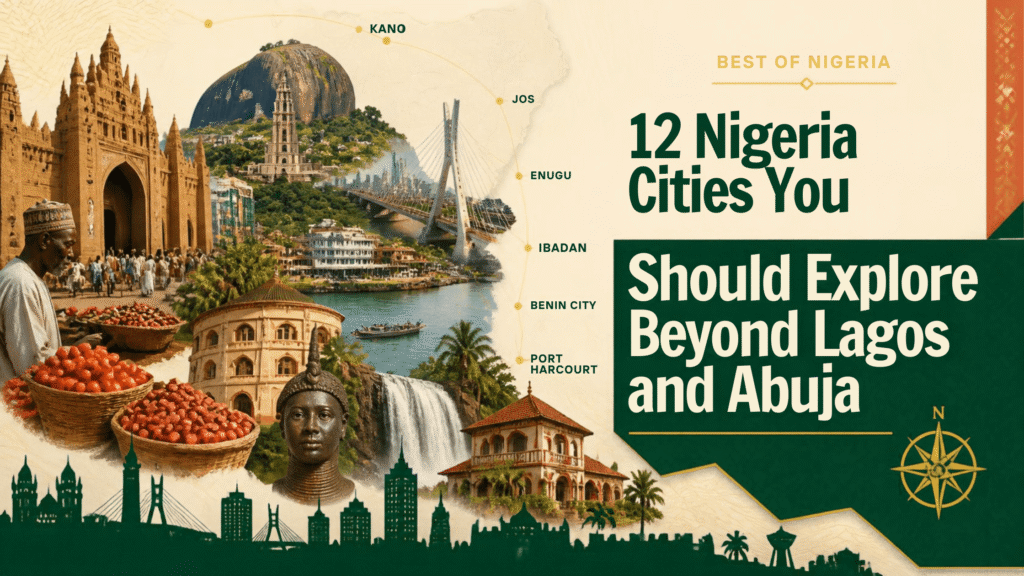
Lagos gets the headlines.
Abuja gets the capital-city attention.
But if Lagos and Abuja are the only Nigerian cities on your travel list, you are missing a huge part of the country.
Nigeria has more than 250 ethnic groups, hundreds of languages and dramatically different landscapes across its regions.
That diversity becomes much easier to understand when you travel beyond the two cities most visitors know.
There is Kano, with centuries of northern history and traditional institutions.
Ibadan, with its hills, literary history and unmistakable old-city character.
Calabar, where tropical landscapes meet festivals and colonial-era history.
Enugu, surrounded by the hills and forests of the Southeast.
Benin City, home to one of Africa’s most celebrated artistic traditions.
And then there are cities such as Jos, Uyo, Abeokuta and Ilorin, each with their own pace, food, landscapes and stories.
Here are 12 Nigerian cities worth putting on your travel map.
1. Ibadan, Oyo State
Ibadan is one of those cities that becomes more interesting the longer you spend in it.
It does not always try to impress you immediately.
Instead, the city reveals itself through its hills, old neighbourhoods, markets, universities, food spots and enormous sense of history.
The city grew into a major centre of political, educational and commercial activity in the Southwest. Its famous Mapo Hall remains one of its most recognisable landmarks, while Cocoa House represents an important chapter in the history of the region’s cocoa economy.
Ibadan is also a city of books and ideas.
The University of Ibadan has played a major role in Nigerian intellectual and literary life, while the city has long attracted writers, academics, artists and journalists.
Then there is the food.
Amala, ewedu, gbegiri and assorted are not merely dishes here. They are part of the city’s everyday identity.
If Lagos feels like Nigeria at full speed, Ibadan can feel like a city where you have enough time to look around.
Don’t miss: Mapo Hall, Cocoa House, Agodi Gardens, University of Ibadan, Bower’s Tower and the city’s traditional food scene.
2. Kano, Kano State
Kano is one of the cities you visit when you want to understand how deep Nigerian history goes.
Its history as a major commercial and cultural centre predates modern Nigeria by centuries.
The ancient city, traditional markets, historic walls, Dala Hill and emirate institutions offer a very different experience from the coastal cities of southern Nigeria.
The Ancient Kano City Walls and Associated Sites are currently on Nigeria’s UNESCO Tentative List. UNESCO’s description includes the historic walls, Dala Hill, Kurmi Market and the Emir’s Palace among the associated heritage features.
And then there is Durbar.
When the ceremonial horsemen appear during major celebrations, Kano becomes one of the most visually spectacular cities in Nigeria.
Durbar in Kano was inscribed on UNESCO’s Representative List of the Intangible Cultural Heritage of Humanity in 2024.
Kano is also an important destination for anyone interested in northern Nigerian cuisine, textiles, leatherwork and traditional crafts.
Don’t miss: Ancient Kano City Walls, Dala Hill, Kurmi Market, the Emir’s Palace and Durbar when the timing is right.
3. Calabar, Cross River State
Calabar has a different rhythm.
The Cross River State capital combines tropical scenery, history, food and one of Nigeria’s most recognisable festival traditions.
Its location near the Cross River and proximity to some of the country’s most important rainforest landscapes give it a natural advantage as a tourism base.
But Calabar’s cultural identity is just as important.
The city is closely associated with the Calabar Carnival, which transforms its streets into a huge celebration of costumes, music, dance and performance.
There is also a strong historical dimension.
Calabar’s position on the coast made it important to centuries of regional trade, and parts of the city still contain architecture and landmarks connected to its colonial-era history.
It is also a useful base for exploring Cross River’s wider attractions, including the Obudu area and rainforest destinations.
Don’t miss: Calabar Carnival, Marina Resort, the city’s historic districts, local Efik cuisine and the wider Cross River landscape.
4. Enugu, Enugu State
Enugu is sometimes called the Coal City, a reference to the coal deposits that shaped its early modern development.
But there is much more to the city than its mining history.
Enugu sits among hills and green landscapes that give it a noticeably different feel from many other major Nigerian cities.
The city’s history is also closely connected to the development of southeastern Nigeria.
Its cultural scene includes music, film, food, fashion and a growing hospitality industry.
For visitors, Enugu works particularly well as a base for exploring the surrounding region.
Nearby attractions include the Ngwo Pine Forest and caves, while the wider Southeast offers destinations connected to Igbo history and culture.
Enugu is also a city worth exploring slowly.
Find a local restaurant.
Spend time around Independence Layout.
Explore its hills.
Then let the city introduce itself.
Don’t miss: Ngwo Pine Forest and Caves, Milken Hill, Nike Lake area, local restaurants and Enugu’s historic districts.
5. Benin City, Edo State
Benin City is essential for anyone interested in Nigerian art and history.
The city was the centre of the historic Benin Kingdom, one of the most significant states in precolonial West Africa.
Its artistic traditions became internationally famous through the extraordinary works now commonly known as the Benin Bronzes.
But seeing photographs of those works in museums abroad is not the same as understanding the civilisation that produced them.
In Benin City, the royal institution, palace traditions, local arts and wider Edo culture provide context.
The city also offers a different perspective on Nigerian history, one in which sophisticated political institutions, specialised craftsmanship and international trade existed long before colonial rule.
The Benin Iya/Sungbo’s Eredo site is among Nigeria’s UNESCO Tentative List properties, reflecting the wider importance of the region’s historic landscapes.
Don’t miss: The National Museum Benin City, the Oba’s Palace area, traditional arts and crafts, and the city’s historic cultural institutions.
6. Jos, Plateau State
Jos is one of Nigeria’s most distinctive cities.
Its location on the Plateau gives it a cooler climate and a landscape of hills, valleys and dramatic rock formations.
For many Nigerians, Jos has long been associated with its weather.
For visitors, the surrounding landscape is part of the attraction.
The city also has a strong history of art, mining and cultural interaction, reflecting the diversity of communities that have made the Plateau home.
Jos is particularly good for travellers who want a slower trip built around nature, food and exploration rather than nightlife.
You can spend the morning exploring the city, head into the hills in the afternoon and end the day with local food.
Don’t miss: Shere Hills, Jos Wildlife Park, National Museum Jos and the city’s surrounding Plateau landscapes.
7. Uyo, Akwa Ibom State
Uyo is one of the cleaner, calmer and more organised-feeling urban destinations in southern Nigeria.
The Akwa Ibom capital has invested heavily in roads, public spaces, hospitality and tourism infrastructure, giving the city a reputation as a comfortable base for exploring the state.
But the biggest reason to visit is what lies beyond the city.
Akwa Ibom has a strong food culture, beautiful coastal environments and access to destinations such as Ibeno Beach and the wider Niger Delta landscape.
Uyo itself works well for a relaxed weekend.
Eat.
Explore.
Stay somewhere comfortable.
Then use the city as a base for discovering more of Akwa Ibom.
Don’t miss: Ibom Plaza, Ibom Tropicana, local food, cultural performances and day trips into the wider state.
8. Abeokuta, Ogun State
Abeokuta is one of the easiest Nigerian cities to understand through its defining landmark.
Olumo Rock.
The massive granite formation rises above the city and has been closely associated with Abeokuta’s history and identity.
But the city is more than the rock.
Abeokuta has a long history connected to the Egba people and remains an important centre of Yoruba culture.
The city’s architecture, markets, traditional institutions and food scene make it worth exploring after you finish climbing.
Abeokuta is also particularly attractive for a short road trip from Lagos.
You can leave Lagos in the morning, explore the city, visit Olumo Rock, eat local food and return—or stay overnight and slow down.
Don’t miss: Olumo Rock, Ake Palace, Itoku Adire Market and the city’s historic neighbourhoods.
9. Ilorin, Kwara State
Ilorin sits at an interesting cultural crossroads.
Its history connects northern and southwestern influences, giving the city a cultural identity that does not fit neatly into one regional box.
The city is strongly associated with Islamic scholarship and traditional institutions, while its location has also made it an important commercial and educational centre.
For visitors, Ilorin provides an opportunity to experience a different side of the North-Central region.
The food, clothing, religious architecture, traditional crafts and markets all reflect the city’s layered history.
It is also a useful gateway to other attractions in Kwara State.
If your idea of travelling through Nigeria is only Lagos-Abuja-Calabar, Ilorin adds another cultural dimension.
Don’t miss: Emir’s Palace area, central mosque, traditional markets, local food and Ilorin’s craft traditions.
10. Akure, Ondo State
Akure is a good base for discovering some of southwestern Nigeria’s natural and cultural attractions.
The Ondo State capital sits within a region known for hills, forests, farms and traditional Yoruba communities.
One of the major reasons to make the trip is the wider landscape.
Idanre Hills is nearby, and UNESCO currently includes Oke Idanre (Idanre Hill) on Nigeria’s Tentative List. UNESCO describes the hills as a landscape with historic and cultural significance, including festivals that continue to connect the community with the site.
Akure itself offers an opportunity to experience everyday life in a major southwestern city without the scale and intensity of Lagos.
Use it as both a city destination and a base for exploration.
Don’t miss: Deji’s Palace area, local markets, traditional food and a trip to Idanre Hills.
11. Makurdi, Benue State
Makurdi is sometimes overlooked by travellers, which is precisely why it deserves a place on this list.
The Benue State capital sits along the River Benue, giving the city a strong relationship with one of Nigeria’s major waterways.
Benue is also widely associated with agriculture and food.
The state’s reputation as the “Food Basket of the Nation” reflects the importance of farming to its economy and identity.
For visitors, Makurdi offers something different from the more heavily promoted tourist cities.
It is a place to experience the Middle Belt through its food, river landscapes, markets and everyday life.
A visit here is less about ticking off famous monuments and more about understanding another part of Nigeria.
Don’t miss: River Benue views, local food, Makurdi’s markets and the wider agricultural landscape of Benue State.
12. Port Harcourt, Rivers State
Port Harcourt is one of Nigeria’s major commercial cities and the economic centre of much of the Niger Delta.
The city has a different energy from Lagos.
It is smaller, but its connection to the oil industry, riverine communities, entertainment and commerce gives it a distinct character.
Port Harcourt also has a strong food culture.
Being in Rivers State means seafood and other Niger Delta flavours feature prominently in the region’s cuisine.
For travellers, the city can also serve as a starting point for exploring the wider Niger Delta—although trips into riverine areas require more planning and local knowledge.
Spend time experiencing the city rather than using it only as a transit point.
Don’t miss: Port Harcourt’s food scene, cultural events, waterfront areas and nearby Niger Delta destinations.
Why These Cities Are Worth Exploring
One of the easiest mistakes to make when travelling around Nigeria is to treat the country as if it has one culture.
It doesn’t.
The contrast between Kano and Calabar alone makes that obvious.
So does the difference between Ibadan and Jos.
Or Benin City and Uyo.
Or Abeokuta and Makurdi.
Nigeria’s diversity is not just something you read about.
You experience it through changes in food, language, architecture, clothing, music, landscape and everyday life.
UNESCO currently lists only two Nigerian properties on the World Heritage List, Osun-Osogbo Sacred Grove and Sukur Cultural Landscape; but Nigeria has another 13 sites on its Tentative List, including Ancient Kano City Walls, Oke Idanre, Ogbunike Caves and Gashaka Gumti National Park.
That tells only part of the story.
Many of Nigeria’s most interesting experiences are not UNESCO sites at all.
They are neighbourhoods.
Markets.
Restaurants.
Festivals.
Palaces.
Roadside food stalls.
Local galleries.
Family-owned businesses.
Hills.
Beaches.
Rivers.
And conversations with people who know their city better than any guidebook.
Start With One City
You do not have to plan a month-long Nigerian road trip.
Pick one city.
Stay for a weekend.
Eat its food.
Visit its landmarks.
Talk to people.
Explore beyond the obvious tourist attractions.
Then come back and try another.
Lagos and Abuja may be the country’s most internationally recognisable cities, but they are only the beginning.
There is much more Nigeria waiting beyond them.
