10 Nigerian Traditions That Are Still Alive Today
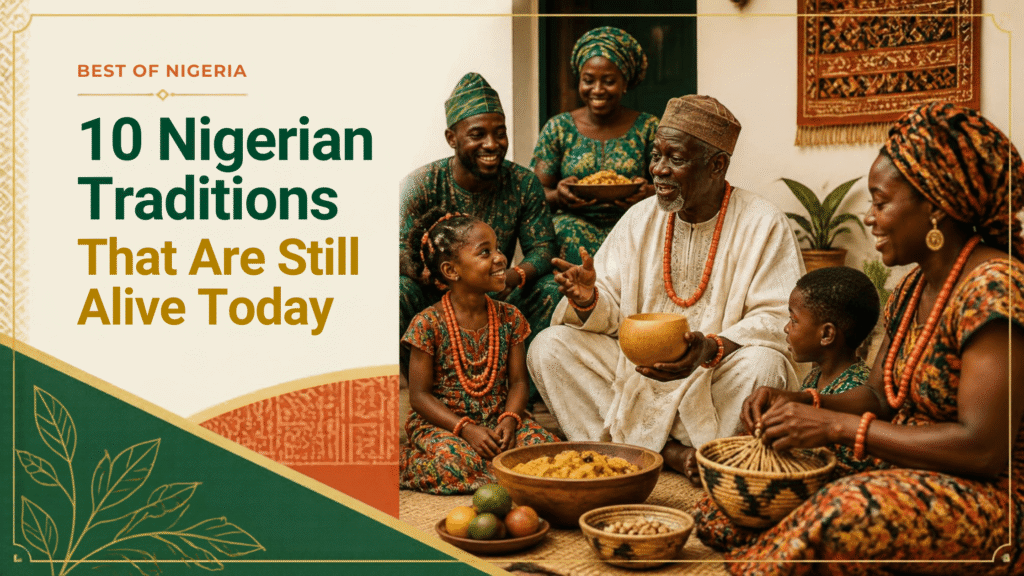
Nigeria is modernising quickly.
Cities are expanding, technology is changing how people work and communicate, and younger Nigerians are building lives that can look very different from those of their grandparents.
Yet some traditions have refused to disappear.
They have changed shape. Some have moved from village squares to city centres. Some are now celebrated alongside Christianity or Islam. Some have become major public festivals. Others continue quietly within families and communities.
That is what makes them interesting.
Tradition does not always mean doing something exactly as people did hundreds of years ago. Sometimes it means carrying an idea, ceremony, craft, story or practice forward while allowing it to adapt to a new generation.
UNESCO currently recognises eight Nigerian elements on its Representative List of the Intangible Cultural Heritage of Humanity, including Durbar in Kano, the Sango Festival of Oyo, the Ijele masquerade, Ifa divination and the oral heritage of Gelede. UNESCO’s 2026 work in Nigeria also stresses that safeguarding heritage means keeping these practices alive and transmitting them within communities.
Here are 10 Nigerian traditions that remain part of contemporary life.
1. Traditional Naming Ceremonies
In many Nigerian communities, the arrival of a child is followed by a naming ceremony that brings family, friends and community members together.
The details vary considerably between ethnic groups and families.
Names may carry meanings connected to circumstances surrounding a child’s birth, family history, aspirations, religion, ancestors or gratitude. Some families also give children traditional names alongside Christian or Muslim names.
The ceremony itself can involve prayers, blessings, food, music, speeches, gifts and introductions to members of the extended family.
The important point is that naming is not simply about choosing what will appear on a birth certificate.
It can be a way of formally welcoming a child into a family and community.
A 2026 Guardian Nigeria feature on Nigerian birth traditions notes that naming customs differ across the country’s ethnic communities while continuing to function as expressions of community, spirituality and identity.
The modern version may take place in a Lagos apartment, an Ibadan event centre or a family home rather than a traditional compound.
The principle remains.
A child is being introduced to a community.
2. Traditional Marriage Ceremonies
Nigerian weddings have changed dramatically, but traditional marriage ceremonies remain deeply visible.
Depending on the community, ceremonies can involve family introductions, negotiations, bride-price or marriage-gift customs, exchange of gifts, traditional clothing, music, food and symbolic rites.
There is no single Nigerian traditional wedding.
A Yoruba engagement ceremony is not the same as an Igbo traditional marriage. Northern Nigerian customs differ from those of the South. Practices can also vary between communities within the same ethnic group.
Yet one feature appears repeatedly:
Marriage is treated as a relationship involving families and communities, not simply two individuals.
Modern couples may also combine traditional ceremonies with church weddings, mosque ceremonies or civil registration.
This ability to combine old and new is one reason the tradition remains relevant.
Traditional marriage ceremonies are not frozen in time.
They continue to evolve.
3. Wearing Traditional Fabrics and Clothing
Traditional Nigerian clothing remains part of everyday cultural expression, especially during ceremonies, festivals, religious celebrations and important social occasions.
Aso-oke, adire, Ankara, woven fabrics and other locally significant textiles continue to appear in contemporary Nigerian fashion.
But traditional clothing is no longer restricted to older generations.
Younger Nigerians routinely reinterpret traditional fabrics through modern tailoring.
Aso-oke can become a blazer.
Adire can become a dress.
Traditional embroidery can appear on a contemporary kaftan.
An agbada can be paired with modern accessories.
This is an important distinction.
Tradition survives not simply because people preserve old designs exactly as they were, but because people continue to find new reasons to wear them.
Nigeria’s fashion industry has increasingly brought traditional craftsmanship into contemporary design, giving old techniques new audiences.
The result is heritage that can appear at a naming ceremony on Saturday and on a fashion editorial the following week.
4. Festivals That Still Bring Communities Together
Across Nigeria, traditional festivals remain important moments for communities to reconnect with history, spirituality and identity.
Some have become major public cultural events.
The Sango Festival in Oyo, for example, marks the beginning of the Yoruba traditional New Year in August. UNESCO describes it as a ten-day festival involving rites, chanting, storytelling, drumming and dancing, with knowledge transmitted to younger generations through participation and observation. It was inscribed on UNESCO’s Representative List in 2023.
The Argungu International Fishing and Cultural Festival remains another major example from north-western Nigeria, while festivals such as Osun-Osogbo continue to connect cultural practice, community and place.
These events show that tradition does not necessarily disappear when a country modernises.
Sometimes modern infrastructure gives tradition a larger stage.
5. Durbar and the Tradition of Horse Culture in Northern Nigeria
Few Nigerian cultural spectacles are as recognisable as Durbar.
The tradition is particularly associated with northern emirates and is prominently practised in Kano.
Horsemen dressed in elaborate traditional clothing ride in procession as part of major ceremonial occasions, including Eid celebrations.
It is a striking combination of horsemanship, pageantry, music, dress and traditional authority.
UNESCO inscribed Durbar in Kano on its Representative List in 2024. Its description identifies the procession as involving thousands of people on horseback and on foot and connects it to Eid al-Fitr and Eid al-Adha celebrations.
The tradition also demonstrates how cultural practices can carry multiple meanings.
For some, it is a religious celebration.
For others, it is an expression of history, community and traditional institutions.
For visitors, it is an extraordinary cultural spectacle.
And for younger generations within the communities involved, it remains something to participate in and inherit.
6. Masquerade Traditions
Masquerades remain an important part of cultural life in several Nigerian communities, particularly during festivals, celebrations, funerals and other significant occasions.
The costumes can be enormous and elaborate.
Music, dancing, storytelling and performance accompany the appearance of the masquerades.
But masquerades are not simply entertainment.
Their meanings differ between communities and may involve spirituality, ancestral relationships, social organisation, history or community identity.
The Ijele masquerade of south-eastern Nigeria is one of the clearest examples.
UNESCO describes Ijele as a large masquerade tradition practised in communities in Anambra State during celebrations, burial ceremonies and other special occasions. The costume can reach around four metres in height and involves extensive community craftsmanship.
Ijele was inscribed on UNESCO’s Representative List in 2009.
The fact that it remains a living practice is significant.
The costume, music, preparation and performance require knowledge to be passed from one generation to another.
7. Ifa and Other Systems of Traditional Knowledge
Traditional knowledge has also survived alongside Nigeria’s modern religious and social systems.
The Ifa divination system, associated particularly with Yoruba communities, is one of the most internationally recognised examples.
UNESCO describes Ifa as a system involving an extensive corpus of texts and mathematical formulas and notes that it is practised among Yoruba communities as well as in parts of the African diaspora in the Americas and Caribbean. It was inscribed in 2008.
Ifa is more than a ceremony.
It contains an extensive body of oral and intellectual knowledge transmitted through specialised practitioners.
Its survival demonstrates that traditional knowledge does not necessarily disappear simply because modern education, technology and other belief systems exist alongside it.
Different Nigerians relate to traditional systems in different ways.
For some, they remain active spiritual practices.
For others, they are primarily part of cultural heritage and historical identity.
That distinction matters.
Not every Nigerian participates in every tradition, and no single traditional practice represents all Nigerians.
8. Oral Storytelling, Proverbs and Folklore
Before smartphones, streaming platforms and social media, stories travelled by word of mouth.
And they still do.
Nigerian communities have long used stories, proverbs, songs, praise poetry and folklore to pass knowledge between generations.
Parents and grandparents tell children stories.
Elders explain the meaning behind proverbs.
Communities preserve histories through oral accounts.
Even contemporary Nigerian entertainment frequently draws from these traditions.
Characters, sayings, myths and storytelling structures that once belonged primarily to oral culture can now appear in books, films, music, theatre, advertising and social media.
UNESCO’s recognition of the oral heritage of Gelede is a particularly strong example. The tradition combines masks, dance, chants, music and oral performance, with songs conveying histories and myths of Yoruba-Nago communities.
The technology has changed.
The instinct to tell stories has not.
9. Traditional Foodways and Communal Eating
Food is one of the easiest ways to see tradition continuing in everyday Nigerian life.
Nigerians still prepare dishes using ingredients, techniques and combinations passed down through families and communities.
The exact foods differ by region.
A family in the Southwest may have its own traditions around amala and ewedu.
A family in the Southeast may prepare dishes based on local vegetables, yam, cassava or palm products.
Northern communities have their own food traditions involving grains, meat, dairy, spices and local ingredients.
Riverine communities have food cultures shaped by fish, seafood and their environment.
But food traditions are not just about recipes.
They are also about when people eat, who prepares the food, how food is served and who eats together.
A large pot of food at a family gathering can perform a social function just as important as the meal itself.
Food connects generations.
Grandparents teach recipes.
Parents modify them.
Children grow up with them.
Restaurants then introduce them to new audiences.
That is how a food tradition moves from a family kitchen into contemporary culture.
10. Traditional Craftsmanship
Nigeria’s traditional crafts remain alive through people who continue to make things by hand.
Weaving, dyeing, carving, pottery, embroidery, leatherwork, beadwork, metalwork and other forms of craftsmanship continue to exist in different communities.
Some are practised primarily for cultural or ceremonial purposes.
Others have entered modern commerce.
A traditional craft can become a fashion accessory.
A woven textile can become contemporary clothing.
A carved object can become a decorative piece.
A traditional pattern can inspire a modern brand.
This commercial adaptation can create new opportunities, but it also raises an important question: how can traditional knowledge remain meaningful to the communities that created it while participating in modern markets?
UNESCO’s current work in Nigeria specifically emphasises community-based safeguarding and the transmission of living heritage rather than treating cultural heritage simply as objects to be preserved.
That distinction is important.
A craft tradition is alive when people still know how to make it, teach it, use it and find reasons to continue making it.
Tradition Is Not the Opposite of Modern Nigeria
One of the easiest mistakes when talking about Nigerian culture is to imagine tradition and modernity as two opposing worlds.
They are not.
A young Nigerian can use an iPhone, work remotely, listen to Afrobeats, wear sneakers and still participate in a traditional wedding.
Someone can live in Lagos and travel internationally while returning to their hometown for a festival.
A designer can use a centuries-old textile technique to create contemporary clothing.
A filmmaker can take an old folktale and turn it into a modern story.
A family can combine traditional naming customs with Christian or Muslim practices.
This is how culture survives.
It changes without necessarily disappearing.
Why These Traditions Still Matter
Traditions provide more than nostalgia.
They can provide identity.
They give communities ways to mark important moments, remember history, teach younger generations and maintain relationships between people and place.
They can also create economic opportunities.
Festivals bring visitors.
Crafts support artisans.
Fashion creates markets for traditional textiles.
Food creates businesses.
Cultural events support musicians, performers, photographers, designers, caterers and other workers.
But there is also a responsibility that comes with turning culture into an industry.
Traditions belong first to the communities that practise them.
Commercialisation can help keep a tradition visible and economically viable, but it can also simplify or distort practices when cultural meaning is removed entirely.
UNESCO’s discussion of Gelede, for example, explicitly notes concerns about traditional knowledge loss and the risk of tourism turning heritage into a folklore product.
The challenge is therefore not simply to make Nigerian traditions popular.
It is to keep them meaningful.
The Future of Nigerian Tradition
Nigeria’s traditions are not standing still.
Some will change.
Some will become less common.
Some may disappear.
Others may experience a revival because younger Nigerians find new meaning in them.
That is already happening in fashion, music, festivals, food and visual art.
The future of Nigerian tradition may therefore look very different from its past.
It may involve social media creators documenting festivals.
Designers may reinterpret indigenous textiles.
Filmmakers may build stories around folklore.
Young entrepreneurs may turn traditional crafts into global brands.
Musicians may sample traditional rhythms.
And families may continue ceremonies that have been performed for generations while changing almost everything else about the way they live.
That is not necessarily the loss of tradition.
It can be its next chapter.
Nigeria’s Living Heritage
Nigeria is often described through its future: technology, entertainment, entrepreneurship, fashion and rapidly growing cities.
But its past is still present.
It can be heard in a proverb.
Seen in a masquerade.
Worn in a fabric.
Tasted in a family recipe.
Performed at a festival.
Remembered through a story.
Practised in a ceremony.
And taught by one generation to another.
That is what makes these traditions living heritage.
They are not simply things Nigerians remember.
They are things Nigerians continue to do.
And as long as people keep practising, adapting and passing them forward, Nigeria’s traditions will continue to have a place in its future.
