30 Nigerians Making an Impact Across the World
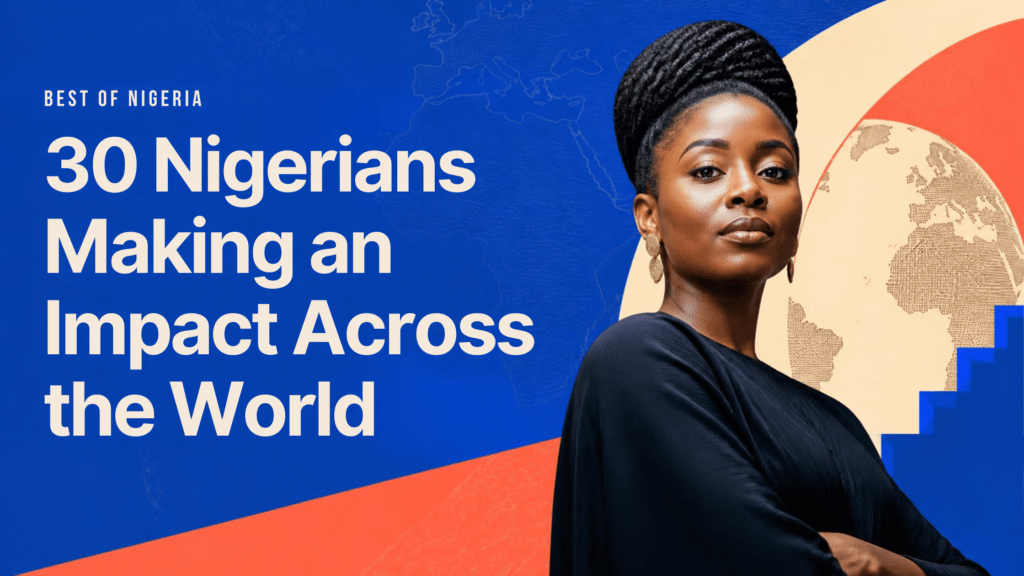
Nigeria’s influence is no longer confined to its borders.
From boardrooms in London and New York to laboratories in the United States, football stadiums in Europe, galleries in Berlin, universities in Oxford and concert stages around the world, Nigerians are contributing to industries that shape how people live, work and see the world.
Some built companies. Some are changing medicine. Others are writing books, designing buildings, making music, competing at the highest level of sport or opening doors for the next generation.
Their stories are different, but together they show something important about Nigeria’s global footprint: it is much bigger than the headlines that usually define the country.
Here are 30 Nigerians whose work, careers or creative influence extend well beyond Nigeria.
1. Ngozi Okonjo-Iweala, Global Trade and Development
Few Nigerians occupy a more significant position in the global economic system than Ngozi Okonjo-Iweala.
The economist and former Nigerian finance minister became the first woman and first African to lead the World Trade Organization. She began her second four-year term as WTO Director-General in September 2025 and continues to play a central role in international discussions around trade, development and the global economy.
Her career has also included more than two decades at the World Bank, where she rose to Managing Director.
For Nigeria, her influence extends beyond the positions she has held. She represents the growing number of Nigerians participating directly in decisions that affect international commerce and development.
2. Aliko Dangote, African Industry
Aliko Dangote’s business empire is one of the most recognisable examples of African entrepreneurship operating at continental scale.
Through Dangote Group, he has built businesses spanning cement, food manufacturing, fertiliser and energy. The Dangote Refinery has added another major industrial project to that portfolio.
In 2026, TIME included Dangote in its TIME100 list of the world’s most influential people. The profile highlighted his long-running focus on African industrialisation and the development of businesses on the continent.
His story has become closely associated with the idea that large-scale industrial businesses can be built from Africa for African and international markets.
3. Tony Elumelu, Entrepreneurship and Investment
Tony Elumelu has built an international career around banking, investment and entrepreneurship.
Through Heirs Holdings, Transcorp and the Tony Elumelu Foundation, he has combined business investment with programmes aimed at supporting entrepreneurs across Africa.
His influence reaches beyond the companies he owns. The Tony Elumelu Foundation’s entrepreneurship programme has helped thousands of African entrepreneurs access training, mentorship and seed capital.
Elumelu has also become a prominent voice in international conversations about African entrepreneurship and private-sector development.
4. Adebayo Ogunlesi, Global Finance and Infrastructure
Adebayo Ogunlesi has spent decades operating at the intersection of international finance and infrastructure.
The Nigerian-born investment banker and investor has held senior positions in global financial institutions and became chairman and CEO of Global Infrastructure Partners, which manages infrastructure investments across sectors and markets.
His career illustrates a different dimension of Nigerian global influence: Nigerians are not only building companies; they are also helping finance and manage major infrastructure assets around the world.
5. Benedict Oramah, African Trade and Finance
Benedict Oramah has been a major figure in African trade finance.
The Nigerian economist served as President and Chairman of the Board of Directors of Afreximbank from 2015 to 2025, overseeing a period in which the institution expanded its role in intra-African trade, industrialisation and investment.
His tenure placed a Nigerian at the centre of efforts to build financial infrastructure for a more integrated African economy.
6. Shola Akinlade, African Technology
Shola Akinlade is one of the Nigerian technology entrepreneurs whose work has reached far beyond Nigeria.
As co-founder of Paystack, he helped build payment infrastructure that enabled African businesses to accept online payments more easily. Stripe acquired Paystack in 2020, in one of the landmark transactions in African technology.
Paystack has since expanded its operations across multiple African markets, while Akinlade has also become involved in initiatives around football, education and technology.
His career demonstrates how a product built around a distinctly Nigerian problem can eventually become part of a much larger global technology ecosystem.
7. Olugbenga “GB” Agboola, Global Payments
GB Agboola is another Nigerian founder whose work has taken African technology onto the international stage.
He co-founded Flutterwave, a payments technology company that helps businesses process transactions across African and international markets.
In 2026, Flutterwave was among five Nigerian companies selected for Endeavour’s global Outliers programme. Endeavor noted that the Nigerian companies in the cohort collectively operated across more than 46 countries and six continents.
Agboola’s story is part of a broader shift: Nigerian technology founders are increasingly building companies designed for international markets from the beginning.
8. Iyinoluwa Aboyeji, Startup Building and Venture Capital
Iyinoluwa Aboyeji has been involved in several of the companies and institutions that have shaped Africa’s startup ecosystem.
He co-founded Andela and Flutterwave and later became a co-founder of Future Africa, an investment platform focused on African technology companies.
His influence therefore extends beyond individual startups. Aboyeji has helped build companies, invest in founders and contribute to the infrastructure surrounding Africa’s technology ecosystem.
9. Temie Giwa-Tubosun, Healthcare Access
Temie Giwa-Tubosun founded LifeBank, a healthcare technology company focused on making critical medical supplies more accessible.
The company’s work has centred on using technology and logistics to help hospitals access blood and other essential medical products.
Her work has attracted international attention because it tackles a problem that is both highly local and globally relevant: how technology can improve the movement of life-saving healthcare supplies.
Giwa-Tubosun’s career has also made her an important voice in conversations about African healthcare innovation.
10. Odunayo Eweniyi, Fintech and Financial Inclusion
Odunayo Eweniyi is one of Nigeria’s prominent technology entrepreneurs and investors.
She co-founded PiggyVest, which grew from a savings-focused product into a broader personal finance platform used by Nigerians to save, invest and manage money.
She has also become increasingly involved in supporting other founders and building the wider Nigerian technology ecosystem.
Her career reflects an important shift in Nigerian entrepreneurship: technology founders are increasingly becoming investors, mentors and ecosystem builders themselves.
11. Oluyinka Olutoye, Medicine and Surgery
Dr. Oluyinka Olutoye is among the Nigerian-born physicians whose work has attracted international medical attention.
He was part of the surgical team behind the remarkable fetal operation that involved temporarily removing an unborn baby from the womb, treating a tumour and returning the baby to the womb before delivery.
The case became internationally known as the “baby born twice” surgery.
Olutoye subsequently became a senior leader in paediatric surgery in the United States. His career demonstrates how Nigerian medical professionals are contributing to highly specialised areas of modern medicine.
12. Olufunmilayo Olopade, Cancer Research
Professor Olufunmilayo Olopade has spent decades advancing cancer research, particularly research into breast cancer genetics and personalised treatment.
Born in Nigeria, she built her academic and medical career in the United States and has become internationally recognised for her work in cancer genetics.
Her research is particularly significant for populations of African ancestry, for whom better understanding of genetic and biological differences can contribute to more targeted approaches to cancer prevention and treatment.
She represents the Nigerian contribution to global scientific research beyond the more visible technology and entertainment sectors.
13. James Chibueze, Astronomy
James Chibueze is helping expand Africa’s contribution to astronomy.
The Nigerian astronomer has worked with major radio astronomy facilities in South Africa and has contributed to research and capacity building in African astronomy.
In 2025, he received the Royal Society’s Rising Star Africa Prize for his work advancing astronomy on the continent.
Nature Africa profiled his journey in 2026, describing his path from rural Nigeria to leading astronomical research and international collaborations.
His work is a reminder that Nigerian scientific talent reaches into some of the most specialised fields of global research.
14. Edu Inam, Science and Research Infrastructure
Professor Edu Inam is contributing to science not only through her own research but also through efforts to improve research infrastructure in Nigeria.
In 2026, the University of Uyo chemistry professor won the inaugural Faculty for the Future Impact Prize from the Schlumberger Foundation.
She was recognised for an initiative designed to improve researchers’ access to scientific equipment and research infrastructure in Nigeria. She was one of nine women scientists and engineers selected from 156 applications across 61 countries.
Her work highlights an important part of scientific progress that is often overlooked: building the systems that allow other researchers to do better work.
15. Nnedi Okorafor, Africanfuturism and Literature
Nnedi Okorafor has helped create a global audience for Africanfuturist storytelling.
The Nigerian-American author has written novels, comics and graphic works that combine speculative fiction with African histories, cultures and ideas about the future.
Her work includes the award-winning Binti trilogy and Who Fears Death, as well as Marvel projects involving Black Panther and Shuri.
Her books have won major science-fiction and fantasy awards, including the Hugo, Nebula, World Fantasy and Locus awards.
Her influence goes beyond publishing. She has helped demonstrate that African settings and perspectives can sit at the centre of globally successful speculative fiction.
16. Chimamanda Ngozi Adichie, Literature and Ideas
Chimamanda Ngozi Adichie has become one of the most recognisable Nigerian literary voices in the world.
Her novels, essays and public speaking have taken Nigerian experiences into international conversations around identity, migration, gender, race, culture and belonging.
UNESCO described her in 2026 as one of the influential voices of her generation, noting the international reach of works including Purple Hibiscus and Americanah.
Adichie’s impact is particularly significant because she has helped make Nigerian experiences part of mainstream global literary conversation without stripping them of their complexity.
17. Wole Soyinka, Literature and Cultural Thought
Wole Soyinka’s influence spans literature, theatre, activism and intellectual life.
He became the first African Nobel laureate in Literature in 1986, and his work continues to be studied, staged and discussed internationally.
His career has stretched across generations, making him one of Nigeria’s most enduring cultural figures.
Soyinka’s importance also lies in the breadth of his work: Nigerian literature has never been his only concern. His writing has consistently engaged with questions of power, freedom, culture and human dignity.
18. Yinka Shonibare, Contemporary Art
Yinka Shonibare has built an international art career around questions of identity, colonialism, migration and cultural exchange.
The British-Nigerian artist is known for works that use African-inspired textiles and European historical references to explore the complicated relationship between Africa and Europe.
His work has appeared in major museums and exhibitions around the world.
Shonibare’s career is significant because it demonstrates how Nigerian heritage can become a starting point for conversations about global history rather than simply a marker of national identity.
19. Toyin Ojih Odutola, Contemporary Art
Toyin Ojih Odutola has become a prominent figure in contemporary art through her drawings and narrative-based visual work.
Her exhibitions have reached major institutions across the United States and Europe.
Her 2025–2026 exhibition activity includes appearances at institutions such as the New Museum in New York, Harvard Art Museums, the Studio Museum in Harlem and Hamburger Bahnhof in Berlin.
Her work often explores identity, family, history and imagined worlds, contributing to a growing global conversation about contemporary African and diasporic art.
20. Kunlé Adeyemi, Architecture and Urbanism
Kunlé Adeyemi has taken Nigerian architectural thinking into international conversations about cities, water and climate resilience.
The architect and founder of NLÉ is particularly known for the Makoko Floating School and his wider work on water-based urbanism.
His practice has developed the Makoko Floating System into a prefabricated architectural approach deployed across several countries and continents. He has also held academic positions at institutions including Harvard and Columbia.
Adeyemi’s work shows how an idea emerging from Lagos can become relevant to cities around the world facing flooding, rapid urbanisation and climate pressures.
21. Wizkid, Global Music
Wizkid has been central to Afrobeats’ transition from a Nigerian and African genre into a global commercial force.
His international collaborations, touring history and streaming audience have helped introduce Nigerian sounds to listeners who may have previously had little exposure to contemporary African pop.
Rolling Stone Africa reported in 2026 that Wizkid had surpassed 10.6 billion Spotify streams across all credits.
His influence is not simply measured in streams. He is part of a generation of Nigerian artists that changed the commercial possibilities of African popular music.
22. Burna Boy, Afrobeats on the Global Stage
Burna Boy has built one of the strongest international careers in contemporary African music.
His music blends Afrobeats with dancehall, reggae, hip-hop and other influences, while continuing to draw heavily from Nigerian musical traditions.
He won the Grammy for Best Global Music Album for Twice as Tall and has continued to receive major international recognition. At the 2026 Grammys, he was nominated for Best African Music Performance and Best Global Music Album.
His international stadium performances and collaborations have also helped demonstrate the commercial scale available to African artists operating globally.
23. Tems, A Global Nigerian Voice
Tems has become one of the most internationally recognised Nigerian singers of her generation.
Her music has connected Nigerian alternative R&B and Afrobeats with global audiences, while collaborations with artists such as Drake, Beyoncé and Future have expanded her international profile.
She won the Grammy for Best African Music Performance in 2025 for “Love Me JeJe” and has accumulated multiple Grammy nominations and two wins.
Tems’ rise also reflects the growing space for Nigerian female artists on the biggest stages in global music.
24. Davido, Nigerian Pop as Global Entertainment
Davido has spent more than a decade building a global audience around Nigerian pop music.
His collaborations with international artists and performances outside Africa have helped establish Afrobeats as a major component of contemporary global pop.
He has received multiple Grammy nominations, including a 2026 nomination for Best African Music Performance for “With You” with Omah Lay.
Beyond his recordings, Davido has also become an important example of how Nigerian artists can operate as global entertainment brands.
25. Ayra Starr, The Next Generation of Afrobeats
Ayra Starr represents a younger generation of Nigerian artists that entered an already globalised Afrobeats industry.
Her music has travelled well beyond Nigeria, and her international collaborations and touring have helped establish her as one of the country’s emerging global pop voices.
She was nominated for the 2026 Grammy for Best African Music Performance alongside Wizkid for “Gimme Dat.”
Her trajectory illustrates how quickly Nigerian artists can now move from local recognition to international audiences.
26. Anthony Joshua, Nigerian Heritage in Global Boxing
Anthony Joshua was born in Watford to a Nigerian mother and Nigerian father and has become one of the most commercially successful British boxers of his generation.
His professional career has included world heavyweight championship reigns and major fights watched by audiences around the world.
Joshua has also maintained a visible connection with Nigeria, making his identity an example of the increasingly global nature of Nigerian communities.
His career demonstrates that Nigerian influence in sport is not limited to athletes competing directly under the Nigerian flag.
27. Tobi Amusan, Nigerian Athletics
Tobi Amusan has become one of Nigeria’s most recognisable athletes internationally.
The hurdler has competed at the highest levels of global athletics and became the first Nigerian world champion in athletics when she won the women’s 100m hurdles at the 2022 World Championships.
She remains a central figure in Nigeria’s international athletics programme, with the Athletics Federation of Nigeria listing her among Team Nigeria’s leading athletes for the 2026 Commonwealth Games.
Her career has helped keep Nigerian athletics visible on the international stage.
28. Victor Osimhen, Nigerian Football Abroad
Victor Osimhen has become one of Nigeria’s most recognisable footballers internationally.
His career in European football, including his time with Napoli, where he helped win the Serie A title, established him as one of Africa’s leading strikers.
His rise has also made him an important figure for a new generation of Nigerian football fans following the country’s players across Europe’s biggest leagues.
29. Ademola Lookman, Nigerian Football on the European Stage
Ademola Lookman’s career has taken him through several European leagues before his breakthrough with Atalanta.
His performances at club level and for Nigeria have brought him significant international attention.
Lookman was a key figure in Atalanta’s historic Europa League triumph in 2024, scoring a hat-trick in the final — one of the most memorable individual performances by a Nigerian footballer in a major European club final.
His story is another example of Nigerian talent succeeding within highly competitive international sporting systems.
30. Yinka Ogunbiyi, Technology and African Innovation
Yinka Ogunbiyi represents a newer type of Nigerian global story: the engineer building technology around an everyday African skill.
The Nigerian-American engineer developed HaloBraid, a braid-assistance robotic system designed to reduce physical strain and improve the efficiency of hair braiding.
Channels Television reported in 2026 that the technology had attracted $7 million in funding and had been adopted by more than 7,000 salons.
The significance goes beyond the product itself. Ogunbiyi’s work shows how an experience rooted in African culture can become the starting point for a technology product with an international market.
The Nigerian Influence Is Bigger Than the Headlines
There is a tendency to talk about Nigeria’s global influence through a handful of familiar categories: Afrobeats, football, Nollywood and technology.
Those categories are real, but they only tell part of the story.
Nigerians are also contributing to cancer research, astronomy, architecture, international trade, contemporary art, financial infrastructure, healthcare, literature and industrial development.
The diaspora plays an important role in that story.
In 2026, Nigeria’s government launched the Hire From Nigeria campaign with the stated goal of connecting Nigerian professionals and skilled workers with international employers and clients. The initiative reflects a broader recognition that Nigerian talent abroad and Nigerian talent working for global markets from home is an economic asset.
Nigerians are therefore influencing the world in two directions: by taking Nigerian ideas, culture and expertise abroad, and by bringing international knowledge, capital and opportunities back into Nigeria.
A Global Nigerian Story
The people on this list work in very different fields.
A WTO Director-General negotiates international trade rules. A surgeon operates on unborn children. An astronomer studies the universe. An architect develops climate-resilient buildings. A novelist changes how readers understand Africa. A musician takes Afrobeats to stadiums around the world. A technology founder builds payment infrastructure for international commerce.
There is no single definition of Nigerian global impact.
Sometimes it is a company employing thousands of people. Sometimes it is a scientific discovery. Sometimes it is a book read in dozens of countries. Sometimes it is simply a song that makes someone on the other side of the world curious about Lagos.
Together, these stories form a larger picture.
Nigeria’s influence is travelling through its people, its ideas, its creativity and its expertise.
And the next generation is already on its way.
