Made in Nigeria: The Rise of Locally Made Furniture and Home Décor
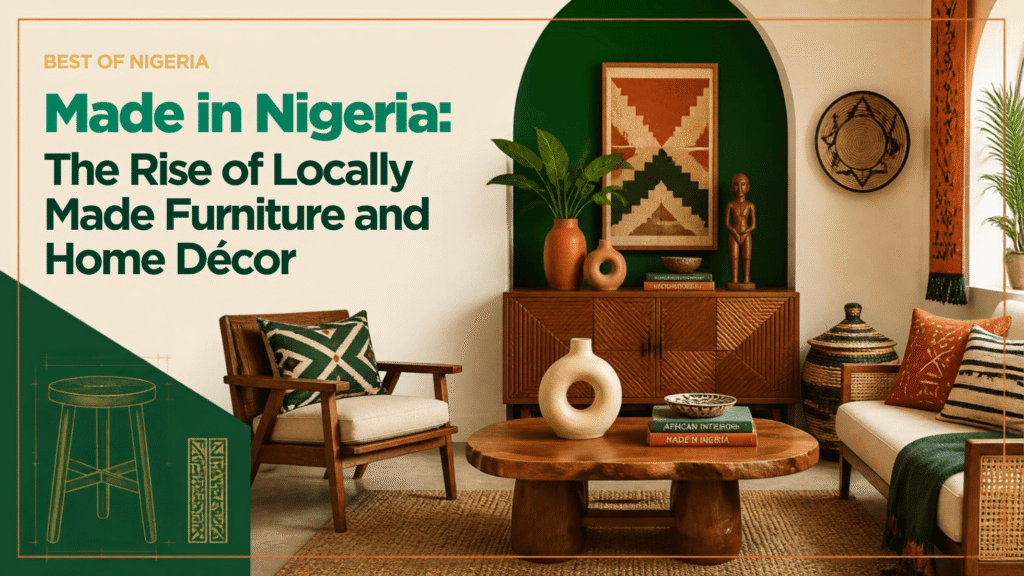
There was a time when buying furniture in Nigeria often meant choosing between imported pieces and something made by a local carpenter.
That distinction is becoming less useful.
Across Lagos, Abuja, Ibadan, Port Harcourt and other Nigerian cities, a new generation of furniture manufacturers and interior brands is changing what locally made furniture can look like.
They are building sofas, dining tables, beds, wardrobes, kitchens, office furniture, doors, lighting and decorative objects.
But the bigger change is not simply the number of things being produced locally.
It is the way those products are being designed, branded, manufactured and sold.
Nigerian furniture is increasingly being treated as a design product, not merely something fabricated to fill an empty room.
That shift matters.
Because once furniture becomes a product, the conversation changes from:
“Can someone make this for me?”
to:
“Which Nigerian brand made the best version of this?”
Nigeria Already Has a Furniture Culture
Furniture manufacturing is not new to Nigeria.
The country has always had carpenters, upholsterers, cabinet makers, woodworkers and artisans producing furniture for homes and businesses.
What is relatively new is the growth of more formal furniture companies combining these skills with modern machinery, professional design, branding, showrooms, e-commerce and large-scale project delivery.
The Nigerian furniture market now includes manufacturers, retailers, artisan workshops, importers, interior designers and turnkey fit-out companies. One 2026 market analysis estimated the Nigerian furniture and interior-design market at about $1.19 billion for 2026, with residential demand supported by housing needs, renovations and furnishing of urban homes.
That creates a substantial opportunity for Nigerian manufacturers.
The market is already here.
The question is how much of it can be supplied by products made here.
Savalani Furniture: From Manufacturing to Complete Spaces
Savalani Furniture is one of the clearest examples of how Nigerian furniture manufacturing has evolved.
The Lagos-based manufacturer produces office furniture, home furniture, kitchens, wardrobes and doors. Its current operation includes more than 70 ergonomic chair SKUs and a 5,500-square-metre manufacturing facility.
The company also produces locally made doors, including certified fire-rated doors.
But perhaps more interesting is the range of projects it handles.
Savalani has worked on residential interiors, offices, restaurants and commercial projects, producing everything from hardwood tables and chairs to wall cladding, ceilings, kitchens and wardrobes. Its projects include furniture made from materials such as teak, iroko, mahogany and other hardwoods.
That is a long way from simply selling a chair.
The business is positioning itself as a manufacturing and spatial-solutions company.
AFP: Nigerian Manufacturing at Industrial Scale
AFP has been manufacturing furniture in Nigeria since 1991, originally as the furniture production arm of Julius Berger Nigeria.
Today, it operates a production facility in Abuja and showrooms in Abuja, Lagos and Port Harcourt.
AFP produces bespoke furniture for residential, corporate and hospitality spaces.
Its catalogue includes sofas, armchairs, dining tables, office furniture and other interior products.
What makes AFP particularly significant is the combination of local manufacturing and industrial standards.
The company says the majority of its materials are sourced locally, while some specialist components come from European suppliers. Its factories use modern machinery and its production teams include designers, architects, wood technicians, engineers and craftsmen.
That combination challenges an old assumption about Nigerian furniture:
local production does not have to mean low-tech production.
FOLM: Putting Nigerian Craftsmanship at the Centre
FOLM represents another direction for the industry.
The Lagos-based furniture manufacturer describes its purpose as reclaiming Nigerian craftsmanship and presenting it through contemporary design.
Its furniture combines local materials, craftsmanship and a more design-led aesthetic, with the company explicitly positioning its work as furniture “made in Nigeria, for the world.”
That positioning is important.
The strongest Nigerian furniture brands are increasingly comfortable treating Nigerian origin as part of the product’s value.
The wood matters.
The craftsmanship matters.
The story matters.
But the finished object still has to work in a modern home.
FOLM’s proposition sits directly in that space between heritage and contemporary living.
HNK Interiors: Building a Furniture Manufacturing Business
HNK Interiors illustrates another important development: interior-design companies are increasingly moving into manufacturing.
In July 2026, the company unveiled a new Design Centre alongside a purpose-built furniture manufacturing facility.
The new manufactory is intended to increase local production capacity while combining modern machinery with skilled artisans. HNK said the facility was part of its transition from an interior-design brand into an integrated design-and-manufacturing business.
The company’s approach is particularly interesting because furniture is being connected to the wider creative economy.
Its Design Centre includes multiple lifestyle environments designed for photography, content creation, events, branding and other creative activities.
That creates a business model where furniture is not simply a product.
It becomes part of an entire lifestyle and design ecosystem.
ATUNDA: When Waste Becomes Home Décor
One of the most interesting developments in Nigerian home décor is happening outside conventional furniture manufacturing.
ATUNDA, founded by Mabayomije Akinyemi-Ekong, turns discarded textile materials into furniture, lighting, home décor and sculptural objects.
Its first collection, the Yaba Collection, uses textile waste recovered from Yaba Textile Market in Lagos.
This is significant for two reasons.
First, it gives discarded material another life.
Second, it turns what might ordinarily be classified as waste into a design material.
That opens a much wider conversation about sustainable Nigerian furniture.
Instead of asking only:
“What materials can we buy?”
designers can increasingly ask:
“What materials are already around us that we can transform?”
Nigerian Hardwood Is Becoming a Design Asset
Nigeria has a long history of working with hardwoods such as mahogany, teak and iroko.
The opportunity today is to move beyond treating these materials simply as construction inputs.
Furniture designers can use local woods as part of a distinctive Nigerian design language.
Savalani, for example, lists mahogany, teak and iroko among its hardwood materials and has produced projects using teak, iroko and hardwood veneers.
FOLM similarly builds its design philosophy around local materials and Nigerian craftsmanship.
This creates an opportunity for Nigerian furniture to develop something that imported mass-market furniture often cannot easily replicate:
a recognisable material identity.
The grain, colour, texture and character of locally sourced materials can become part of the brand.
The Nigerian Sofa Is Getting a Design Upgrade
The sofa may be one of the most competitive furniture categories in Nigeria.
Almost every Nigerian home needs one.
But the market is becoming more sophisticated.
Customers are increasingly interested in:
- modular sofas;
- cleaner silhouettes;
- better upholstery;
- custom sizing;
- contemporary colours;
- durable fabrics;
- minimalist designs;
- statement pieces;
- outdoor furniture.
That gives local manufacturers an advantage.
They can design around the actual dimensions of Nigerian homes.
They can produce unusual sizes.
They can customise fabrics.
They can respond to a customer’s specific space.
And they can modify designs faster than an importer waiting for a shipment.
This ability to customise is one of the strongest reasons local furniture can compete.
Customisation Is a Nigerian Advantage
There is something Nigerian consumers have always understood about furniture:
we like things made for us.
A customer may want a wardrobe that fits an awkward corner.
A dining table may need to fit a particular room.
A kitchen needs to accommodate the actual dimensions of the house.
An office may require a specific workstation configuration.
A locally based manufacturer can visit the site, measure the space, design the product and manufacture it accordingly.
AFP explicitly positions its furniture around bespoke solutions for homes, offices and hospitality spaces.
Savalani similarly offers custom kitchens and wardrobes at different scales, from individual homes to entire apartment developments.
This is not a small advantage.
It is one of the areas where Nigerian manufacturers can compete against mass-produced imports.
Furniture Is Becoming Part of Nigerian Hospitality
Hotels, restaurants, lounges and short-let apartments have created another major market for locally manufactured furniture.
These businesses do not just need individual chairs.
They need entire environments.
Dining tables.
Bar stools.
Beds.
Headboards.
Sofas.
Reception desks.
Outdoor furniture.
Wardrobes.
Lighting.
Doors.
Wall finishes.
The ability to manufacture multiple components locally can make a Nigerian furniture company much more valuable to a hospitality client.
Savalani, for example, lists hotels, restaurants and commercial projects among its work, while AFP operates across residential, corporate and hospitality environments.
This is where furniture manufacturing starts to overlap with architecture and interior design.
Office Furniture Is Becoming More Sophisticated
The modern Nigerian workplace has changed.
Offices increasingly need more than rows of desks.
Companies want meeting spaces, collaborative areas, executive offices, breakout areas, ergonomic seating and visually interesting environments.
Local furniture manufacturers are responding.
Savalani offers more than 70 ergonomic office-chair SKUs alongside desks, workstations, meeting tables and storage solutions.
AFP similarly produces furniture and complete environments for corporate clients.
This creates a market where Nigerian manufacturers are competing not only on carpentry but on workplace design.
Nigerian Doors Are Part of the Story Too
Furniture is only one part of the home.
Doors, wardrobes, kitchens, wall panels and other built-in elements are increasingly being manufactured locally as part of complete interior projects.
Savalani produces locally made doors, including fire-rated doors certified through the International Finance Corporation’s relevant programme, while AFP also has a dedicated locally manufactured door offering.
This is important because it expands the meaning of “Made in Nigeria.”
It is not just:
chair + table + sofa.
It can be:
door + kitchen + wardrobe + wall system + ceiling + furniture + complete interior.
The more categories local manufacturers can handle, the more value remains inside the domestic economy.
Home Décor Is Becoming More Nigerian
There is also a cultural shift happening.
For a long time, contemporary Nigerian interior design could lean heavily toward imported styles.
Today, designers and manufacturers are increasingly experimenting with Nigerian materials, colours, patterns, craftsmanship and cultural references.
The result does not necessarily look traditionally Nigerian.
And that is precisely the point.
A modern Nigerian home does not have to look like a museum.
A chair can use Nigerian wood without looking traditional.
A lamp can incorporate local craft without looking old-fashioned.
A wall feature can reference Nigerian culture without becoming a tourist souvenir.
A textile can become a contemporary cushion, lampshade or upholstered chair.
The most interesting future for Nigerian décor may therefore be subtle cultural expression rather than literal reproduction.
Local Furniture Is Becoming a Lifestyle Brand
This is perhaps the biggest change.
The strongest furniture companies are beginning to behave less like workshops and more like brands.
They have:
- visual identities;
- catalogues;
- showrooms;
- social-media presence;
- product collections;
- professional photography;
- interior projects;
- customer experience;
- online enquiries;
- design consultations.
That matters because people rarely develop an emotional relationship with a carpenter.
They can develop one with a brand.
A furniture brand can create a distinctive design language that customers recognise.
It can release collections.
It can collaborate with architects.
It can work with designers.
It can build a community around interiors.
That creates much more long-term value than simply accepting individual fabrication orders.
The Internet Is Changing How Nigerians Buy Furniture
Furniture is increasingly becoming an online discovery category.
Customers can now browse collections, compare designs, contact manufacturers, request quotations and increasingly place orders without visiting multiple workshops.
That does not mean physical showrooms are disappearing.
Furniture is still tactile.
People want to sit on a sofa.
They want to touch the fabric.
They want to see the colour.
They want to inspect the finishing.
But the customer journey increasingly begins online.
A Nigerian furniture company therefore needs to think about photography, video, websites, catalogues, social media and digital customer service as part of its product.
The furniture may be physical.
The shopping experience is increasingly digital.
The Next Opportunity Is Export
The long-term opportunity is bigger than replacing imported furniture in Nigeria.
It is exporting Nigerian furniture.
That means designing products that can survive international shipping, creating reliable production standards, developing consistent collections and building international distribution.
The idea is already being expressed by companies such as FOLM, which explicitly positions its work around furniture made in Nigeria for the world.
There is also a natural market in the Nigerian and African diaspora.
A Nigerian living in London, Toronto, Houston or Atlanta may want a dining table, chair, artwork or decorative object that carries something of home.
But the opportunity extends beyond Nigerians.
Good design has no nationality requirement.
A beautiful chair made in Lagos can appeal to a buyer in Paris.
A distinctive table made in Abuja can appeal to a hotel in Accra.
A well-designed home accessory made in Ibadan can find a customer anywhere.
The Nigerian story can be the differentiator.
The quality still has to win the sale.
What Is Holding the Industry Back?
The growth of local furniture does not mean the industry has solved its problems.
Manufacturers still face serious challenges.
Power and production costs
Furniture manufacturing requires machinery, and machinery requires reliable energy.
High energy costs can make locally produced furniture significantly more expensive to manufacture.
Imported components
“Made in Nigeria” does not necessarily mean every component is Nigerian.
Manufacturers may still import specialist hardware, fabrics, machinery, fittings, foam, finishes or other components.
AFP, for example, says it sources the majority of its materials locally but also works with European suppliers for certain components.
That is not necessarily a weakness.
The important goal is increasing local value addition where it makes economic sense.
Quality consistency
One excellent chair is not enough.
A manufacturer has to be able to produce 100 chairs to the same standard.
That requires systems, measurements, machinery, trained workers and quality control.
Raw material supply
Sustainable access to quality timber and other materials will become increasingly important as local production expands.
Growth cannot come at the expense of the materials and ecosystems the industry depends on.
Distribution
A manufacturer in Lagos should be able to sell to customers in Abuja, Port Harcourt, Ibadan, Accra or London without building an entirely new business model for each market.
Better logistics and distribution will therefore be critical.
The Future of Nigerian Furniture Is Not Just “Local”
The most interesting Nigerian furniture companies are not succeeding simply because their products are made locally.
They are succeeding because they combine local manufacturing with other advantages:
design + craftsmanship + technology + customisation + branding + distribution.
That is the real formula.
Being Nigerian gives the product an identity.
It does not automatically give it quality.
Quality has to be manufactured too.
And that is why the rise of locally made furniture matters.
It represents a broader change in the Nigerian consumer market.
People are becoming more willing to ask:
Who made this?
Where was it made?
What materials were used?
Can I customise it?
Will it last?
Does it look good enough for my home?
Those are good questions for the industry.
They force manufacturers to become better.
From Carpentry to Product Design
Nigeria has never lacked people who know how to make furniture.
The next chapter is about building companies that know how to create products.
That means developing collections rather than one-off pieces.
It means designing for specific customer groups.
It means understanding materials.
It means building manufacturing systems.
It means investing in photography and branding.
It means creating better retail experiences.
It means thinking about exports.
And it means understanding that furniture is not simply something that occupies space.
It shapes how people live.
The manufacturers emerging across Nigeria are beginning to understand that.
From established factories in Lagos and Abuja to new design-led workshops and creative studios, the country’s furniture industry is moving from informal production toward something more ambitious.
The goal is no longer simply to make a sofa that fits someone’s living room.
It is to create a Nigerian furniture product that someone chooses because they love the design.
That is a much bigger opportunity.
And if the industry gets it right, the next generation of Nigerian homes may not just be furnished in Nigeria.
They may be furnished by Nigerian brands.
