From Aba to Lagos: How Nigerian Manufacturers Are Building Great Products
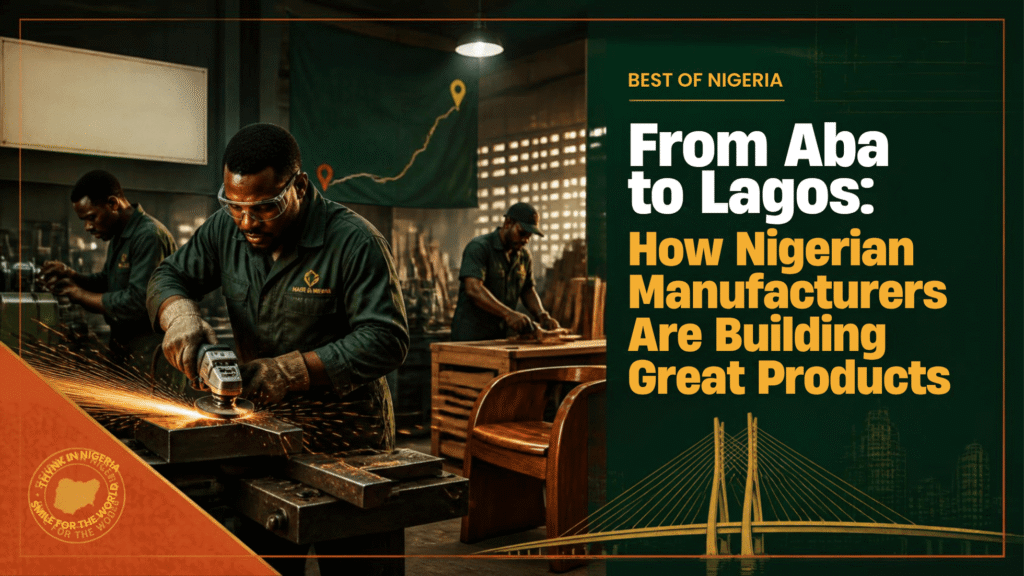
If you want to understand Nigerian manufacturing, start with a simple question:
Where do Nigerians actually make things?
The answer is much bigger than the factories most people see from the highway.
There are automated production lines, industrial estates and large manufacturing plants. But there are also thousands of workshops, tailoring rooms, leather studios, food-processing facilities, furniture factories, fabrication yards and small production floors spread across Nigerian cities.
Aba is one of the clearest examples.
For decades, the Abia city has been known for shoes, bags, garments and leather goods. Around Ariaria International Market and other production clusters, manufacturers have built businesses by turning raw materials into products for customers across Nigeria and West Africa.
But the story is no longer just about Aba.
From Lagos to Ogun, Kano, Anambra, Rivers and other manufacturing centres, Nigerian businesses are building products across food, beverages, pharmaceuticals, furniture, fashion, plastics, building materials, technology and consumer goods.
The interesting part is not simply that Nigerians are making things.
It is that more Nigerian manufacturers are trying to make products people genuinely want to buy.
Aba: Where Manufacturing Became a Culture
Aba’s manufacturing story is unusual because it did not depend entirely on huge industrial companies.
It grew from networks of artisans, traders, workshops and entrepreneurs.
The city became particularly known for footwear, garments, bags and leather products. The Nigerian Investment Promotion Commission describes Aba as one of West Africa’s major manufacturing centres, with a large concentration of artisan workshops and specialist production clusters.
The ecosystem around Ariaria International Market has allowed manufacturers to operate close to suppliers, customers, traders and other producers.
Someone making shoes does not exist in isolation.
Nearby businesses may be cutting leather, producing soles, supplying accessories, repairing machines, selling packaging or distributing finished products.
That proximity creates something larger than individual businesses.
It creates a manufacturing ecosystem.
Recent reporting on Aba’s industrial revival also points to production clusters around Ariaria, Bakassi, Shoe Plaza, Garment Village and the Power Line axis, where manufacturers produce footwear, leather goods, uniforms and clothing for domestic and regional markets.
The Aba Reputation Is Changing
“Aba-made” has not always been associated with premium quality.
For years, locally made products faced a perception problem. Some consumers associated Nigerian manufacturing with inconsistent finishing, copied designs or products that were cheaper rather than better.
That perception is increasingly being challenged.
In 2026, the Abia State Government said the Enyimba Automated Shoe Company and Enyimba Garment Factory had returned to active production, with new machinery and production lines aimed at improving quality and competitiveness.
The development is significant because it points to a broader shift:
Aba’s next chapter cannot simply be about producing more. It has to be about producing better.
Better finishing.
Better sizing.
Better packaging.
Better consistency.
Better quality control.
Better branding.
Better access to international buyers.
That is how a production cluster becomes a globally competitive manufacturing centre.
The Workshop Is Becoming More Industrial
The evolution of Aba also shows why the distinction between “artisan” and “manufacturer” is becoming less useful.
A business can begin with a few workers and basic equipment and gradually introduce cutting machines, automated sewing equipment, industrial finishing equipment and quality-control processes.
A 2024 report on an automated shoe and garment facility in Aba described production lines capable of producing about 1,500 pairs of shoes and 1,500 garments per day.
African Cobblers, an Aba-based indigenous footwear, leather and garment company, has also positioned itself around modernising production and training businesses in the leather and footwear value chain.
That transition matters.
The future of Nigerian manufacturing is unlikely to be purely handmade or purely automated.
It will be a combination of human skill + machinery + design + systems.
Lagos: Where Manufacturing Meets the Consumer
If Aba demonstrates Nigeria’s production culture, Lagos demonstrates the relationship between manufacturing and a huge consumer market.
Lagos is home to manufacturers across food and beverages, chemicals, pharmaceuticals, plastics, furniture, fashion, packaging and other consumer categories.
The city’s importance is not simply that it has factories.
It is also where brands find customers, retailers, distributors, designers, investors, advertising agencies, logistics companies and other businesses required to turn a product into a commercial success.
That combination creates a powerful feedback loop.
A manufacturer can develop a product.
A Lagos consumer can respond quickly.
The brand can adjust.
A retailer can test it.
A distributor can expand it.
A designer can improve its packaging.
And eventually, a product that began in a relatively small production facility can reach consumers far beyond Lagos.
This is one reason Nigeria’s manufacturing story cannot be separated from its commercial cities.
The Food Factory Is the New Farm-to-Shelf Story
Some of the most interesting Nigerian manufacturing is happening in food.
Nigeria has an enormous agricultural base, but agricultural production alone does not create the full value.
The bigger opportunity is what happens after the farm.
Cassava can become flour.
Tomatoes can become paste.
Grains can become breakfast products.
Peppers can become packaged condiments.
Fruits can become drinks.
Groundnuts can become snacks.
This is where food manufacturers are beginning to build stronger Nigerian consumer brands.
The Nigerian Investment Promotion Commission identifies food and beverage manufacturing as a major opportunity, particularly because locally produced agricultural raw materials can be converted into packaged products for the domestic and regional markets.
The opportunity is enormous.
Instead of exporting or selling agricultural commodities with limited processing, Nigerian businesses can capture more value by processing, packaging, branding and distributing finished products.
Furniture Is Becoming a Serious Local Industry
Furniture is another area where Nigerian manufacturing is increasingly visible.
Local manufacturers are producing sofas, beds, tables, office furniture, wardrobes, doors and complete interior solutions.
This matters because furniture is a product category where local manufacturing has a natural advantage.
A Nigerian manufacturer understands Nigerian homes.
They understand the size of local apartments.
They understand climate.
They understand the preferences of Nigerian families.
They can customise.
They can deliver locally.
And they can make adjustments that imported mass-market furniture cannot always accommodate.
The result is a market where Nigerian manufacturers can compete on more than price.
They can compete on design, customisation and proximity.
Fashion Is Moving From Tailoring to Manufacturing
Nigeria’s fashion industry has always had production capacity.
What is changing is the scale and ambition.
There is a difference between making a dress for one customer and building a garment production system capable of producing hundreds or thousands of pieces consistently.
That distinction is becoming increasingly important as Nigerian fashion brands attempt to sell beyond Nigeria.
Manufacturers now have to think about:
- sizing systems;
- production specifications;
- quality control;
- fabric sourcing;
- production timelines;
- packaging;
- inventory;
- wholesale orders;
- export requirements.
The Manufacturers Association of Nigeria recognises textiles, garments, leather processing and footwear as a distinct manufacturing sector, with local value addition and export competitiveness among its priorities.
The opportunity is especially clear in cities such as Aba, Lagos and Kano, where leather, textile and garment production already have deep roots.
Nigerian Leather Has a Bigger Future
Leather may be one of the country’s most interesting manufacturing opportunities.
Nigeria has a long history of leather production, footwear and leather goods. Aba has become particularly associated with shoes and bags, while other production centres contribute to the wider value chain.
The problem has traditionally been less about whether Nigerians know how to make leather products.
They do.
The bigger question is whether the industry can consistently produce at the quality, scale and standard demanded by modern retail and international markets.
That is why initiatives such as the Common Facility Centre for Leather and Leather Products in Aba matter. The Nigeria Export Promotion Council says the centre was established with partners including UNIDO, the Federal Ministry of Trade and Investment and the Abia State Government to help Nigerian leather businesses improve standards, technology and competitiveness.
The opportunity is to move from:
“We can make shoes.”
to:
“We can manufacture a globally competitive footwear collection.”
That is a much bigger proposition.
The Factory Is Not Always a Giant Building
One misconception about manufacturing is that a manufacturer has to look like a multinational corporation.
Nigeria’s reality is different.
A manufacturer might operate from a large industrial plant.
Another might have 20 workers and several specialised machines.
Another may have a production studio with a small team making premium furniture.
Another might process food in a certified facility.
Another might manufacture leather products in a workshop.
They are all part of the manufacturing economy.
The Manufacturers Association of Nigeria’s industrial directory now covers manufacturing capabilities across areas including food and beverages, chemicals and pharmaceuticals, textiles and leather, metals and industrial inputs.
This breadth is important because Nigeria’s manufacturing future will not be built by a handful of mega-factories alone.
It will also be built by thousands of specialised manufacturers.
From Copying Products to Creating Brands
Perhaps the biggest change Nigerian manufacturers need to make is not technological.
It is psychological.
Producing a product is only half the job.
Someone has to decide:
Why should anybody choose this product?
That is where branding enters manufacturing.
A Nigerian manufacturer can produce shoes.
But a Nigerian company can build a footwear brand.
A factory can produce furniture.
But a company can build a furniture identity.
A food processor can package spices.
But a brand can own a particular flavour, audience and category.
This distinction is crucial.
Nigeria does not only need more factories.
It needs more product companies.
Companies that understand manufacturing, design, distribution, marketing and customer experience as one system.
The Distribution Problem
Nigeria is actually quite good at making products.
The harder problem is often getting those products to the right customers consistently.
A manufacturer in Aba might produce excellent shoes but depend heavily on traders.
A furniture manufacturer might make beautiful products but have limited visibility outside its city.
A food processor might have a strong product but struggle to get supermarket shelf space.
A fashion manufacturer might produce at scale but lack international distribution.
This is why manufacturing and distribution have to develop together.
The product needs to move from:
factory → distributor → retailer → consumer
or increasingly:
factory → brand → online store → logistics → consumer.
The more Nigerian manufacturers can control or influence that journey, the more value they can retain.
Quality Is Becoming the Competitive Advantage
For a long time, local manufacturers often competed primarily on affordability.
That model has limits.
The stronger opportunity is to compete on value.
A Nigerian-made product can be affordable and well designed.
It can be durable.
It can have excellent finishing.
It can have attractive packaging.
It can be easy to repair.
It can be customised.
It can understand the local customer better than an imported alternative.
That is where Made in Nigeria becomes commercially powerful.
The goal should not be:
“Buy this because it is Nigerian.”
The goal should be:
“Buy this because it is good and then be proud that it was made in Nigeria.”
The Manufacturing Opportunity Beyond Aba and Lagos
Aba and Lagos make a useful pair for understanding Nigerian manufacturing, but they are only part of the story.
The Nigerian Investment Promotion Commission identifies manufacturing opportunities across several states and sectors, including food and beverages, pharmaceuticals, chemicals, cement and building materials, petrochemicals, plastics, textiles, apparel, leather, FMCG, light manufacturing and industrial equipment.
That means Nigeria’s manufacturing map is much broader than two cities.
Kano has industrial and textile traditions.
Anambra has manufacturing and trading networks.
Ogun has become an important industrial corridor.
Rivers has major industrial and energy-linked activity.
Lagos remains a major commercial and manufacturing centre.
Abia has Aba.
Each ecosystem has different strengths.
The real opportunity is connecting them.
What Nigerian Manufacturers Need Next
The next phase of Nigerian manufacturing will require more than enthusiasm for local products.
Manufacturers need:
Reliable power
Production becomes expensive when factories constantly depend on alternative energy sources.
Better access to machinery
Modern machinery can improve consistency, speed and finishing.
Standards and certification
A product intended for international markets needs to meet the standards expected by international buyers.
Better financing
Manufacturing requires capital for machinery, raw materials, inventory and expansion.
Stronger supply chains
Factories need reliable access to quality raw materials and components.
Better packaging
Packaging is part of the product experience, not an afterthought.
Distribution
Great products still need great routes to market.
Export readiness
The opportunity extends beyond Nigeria into ECOWAS, the wider African market and the global Nigerian diaspora.
The Global Market Is Bigger Than Nigeria
Nigeria’s domestic market alone is enormous.
But the bigger opportunity may be what happens when Nigerian manufacturing starts looking outward more aggressively.
The AfCFTA creates a continental market for African products, while Nigerian manufacturers also have access to diaspora consumers in Europe, North America and elsewhere.
Aba already provides an example of this potential. Businesses within the city’s footwear ecosystem are increasingly looking at export markets, while initiatives such as the Aba Export Growth Lab are designed to help manufacturers improve export readiness.
The question is no longer simply whether Nigeria can manufacture.
It is whether Nigerian manufacturers can build exportable brands.
That is the next frontier.
From Aba to Everywhere
The most exciting part of Nigerian manufacturing is that the country does not have to start from zero.
The skills are already here.
The entrepreneurs are already here.
The markets are already here.
The artisans are already here.
The factories are already here.
The raw materials are here.
What is changing is the ambition.
Aba is showing what happens when thousands of small producers create a manufacturing culture around a city.
Lagos shows what happens when production meets a huge consumer market, capital, design and distribution ecosystem.
Other Nigerian cities are building their own versions of the same story.
The next step is to connect these pieces.
A shoe made in Aba should be able to become a recognisable Nigerian footwear brand.
A food product manufactured in Lagos should be able to reach Accra, London or Atlanta.
A furniture company in Ogun should be able to sell throughout West Africa.
A Nigerian fashion manufacturer should be able to fulfil international wholesale orders.
A locally made consumer product should be able to compete because it is excellent, not because consumers are being asked to make a patriotic sacrifice.
That is the real promise of Made in Nigeria.
Not simply more things made here.
Better things, made here, sold here and eventually sold everywhere.
And from Aba to Lagos, that transformation is already underway.
