10 Nigerian Dishes Everyone Should Try at Least Once
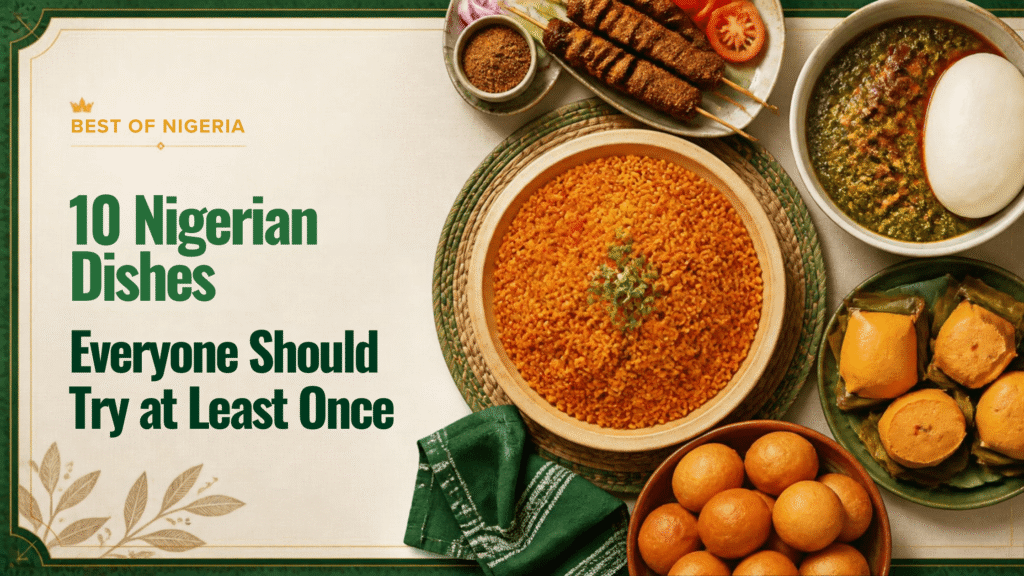
Nigerian food is not one cuisine.
It is a collection of regional traditions, cooking techniques, ingredients and food cultures that happen to exist within one country. The peppery soups of the South, the rice dishes of the North, the grilled meats of the street, the swallows served at family gatherings and the party food that appears at almost every major celebration all tell different parts of the Nigerian story.
That diversity is one reason it is difficult to make a short list of Nigerian dishes.
But if you are new to Nigerian food, whether you live in Nigeria, are visiting for the first time or simply want to explore beyond jollof rice, these 10 dishes offer a good introduction to the country’s range.
1. Jollof Rice
If there is one Nigerian dish most people expect to encounter, it is jollof rice.
Nigerian jollof is made by cooking rice in a deeply seasoned tomato and pepper base, typically built with tomatoes, red peppers, onions and chilli. The rice absorbs the sauce as it cooks, producing the familiar orange-red colour and rich, savoury flavour.
Then there is party jollof.
Cooked in large quantities, often over firewood or intense heat, party jollof can develop the smoky flavour Nigerians famously associate with celebrations. The rice may be served with fried or grilled chicken, beef, goat meat, fried plantain, coleslaw or other sides.
Jollof is much more than everyday rice. It is birthday food, wedding food, Christmas food, naming-ceremony food and one of the dishes that can instantly turn a gathering into a Nigerian gathering.
There is also the never-ending West African debate over which country makes the best jollof.
You do not need to settle that argument before eating it.
Start with Nigerian jollof and understand why the dish has become one of the country’s most recognisable culinary exports.
2. Suya
Suya is what happens when Nigerian street food gets the grill treatment.
Thinly sliced meat, traditionally beef, although chicken and other variations are common, is seasoned with yaji, a spicy dry mixture commonly associated with ground peanuts and pepper, then grilled over charcoal.
The result is smoky, spicy, savoury and intensely aromatic.
Suya is particularly associated with Hausa food culture and has become one of Nigeria’s most recognisable street foods. It is commonly served with sliced onions, tomatoes and additional pepper.
Part of the experience is the setting.
A suya spot after dark, with smoke rising from the grill while freshly seasoned meat is being turned over hot coals, is as much a Nigerian food experience as the meat itself.
For a first-timer, beef suya is the obvious starting point.
Once you are comfortable with that, you can explore chicken, liver, kidney and other variations.
3. Egusi Soup
Egusi soup is one of the dishes that immediately demonstrates how Nigerian soups differ from the idea of a Western soup.
It is thick, rich and designed to be eaten with a swallow.
The defining ingredient is egusi(ground melon seed), which gives the dish its distinctive texture and nutty flavour. Recipes vary considerably between households and regions, but the soup commonly includes peppers, onions, palm oil, stock, leafy vegetables, meat, fish or crayfish.
Egusi is widely eaten across Nigeria and appears in many different regional preparations. TasteAtlas lists it among Nigeria’s most prominent traditional dishes.
The classic way to experience it is with eba, pounded yam, amala or another swallow.
Take a small piece of the swallow, make a little indentation with your fingers, scoop up some egusi and eat the combination together.
That is where the dish really comes alive.
4. Pounded Yam and Soup
Pounded yam deserves its own place because the experience is about more than the soup.
Boiled yam is pounded until it becomes smooth, stretchy and soft, traditionally using a mortar and pestle. Modern kitchens may use mechanical yam pounders or other equipment, but the characteristic texture remains the same.
The pounded yam is then served with a soup such as egusi, efo riro, ogbono or another regional favourite.
For many Nigerians, the texture is the point.
It should be smooth enough to mould easily, stretchy enough to hold together and soft enough to scoop up a generous amount of soup.
Pounded yam also has a cultural history tied to yam cultivation across West Africa, where yam has long been an important crop and food associated with communal meals and celebrations.
If you have never eaten a Nigerian swallow before, pounded yam is one of the easiest places to begin.
5. Moi Moi
Moi moi proves that beans can be transformed into something far more interesting than a simple pot of beans.
The dish is made by blending peeled beans with peppers, onions and seasonings before steaming the mixture into a soft, savoury pudding.
Depending on the recipe, moi moi can contain boiled eggs, fish, crayfish, shrimp, corned beef or other fillings.
It can also be steamed in leaves, which gives it a distinctive appearance and subtle aroma.
Moi moi is particularly associated with Yoruba food culture, although versions of bean-based steamed dishes exist across West Africa.
It works as a meal on its own but is also commonly eaten alongside jollof rice, bread, pap or other foods.
For visitors who are unsure about Nigerian food, moi moi is often an easy introduction because its texture is familiar while the pepper, seasoning and fillings make it distinctly Nigerian.
6. Efo Riro
Efo riro is a rich vegetable-based stew associated particularly with Yoruba cuisine.
The name refers to a vegetable soup, and the dish is commonly prepared with leafy greens, peppers, tomatoes, onions, palm oil and a combination of meat or fish.
It is not simply “vegetable soup” in the bland sense of the phrase.
A properly prepared efo riro can be deeply savoury, peppery and rich, with the greens absorbing the flavour of the stew.
It is usually eaten with a swallow such as eba, amala or pounded yam, although rice and other accompaniments can also work.
TasteAtlas lists efo riro among Nigeria’s most prominent traditional dishes and identifies it as a Yoruba dish.
For anyone exploring Nigerian food beyond the most internationally famous dishes, efo riro is an excellent introduction to the country’s vegetable-and-stew tradition.
7. Afang Soup
Afang soup takes you into the food traditions of southeastern Nigeria, particularly those associated with the Efik and people of Akwa Ibom and Cross River.
The soup gets its name from afang leaves and is commonly prepared with another leafy vegetable, palm oil, meat or fish, crayfish and peppers.
The leaves provide much of its character, while the stock, seafood and palm oil create a rich base.
Afang is often associated with celebrations and important gatherings, although it is also eaten as part of everyday meals.
Like many Nigerian soups, the best way to experience it is with a swallow.
Try it with eba or pounded yam and pay attention to how the texture of the soup, the vegetables and the swallow work together.
It is a very different experience from jollof or suya — and that is exactly the point.
8. Pepper Soup
Pepper soup is one of Nigeria’s great comfort foods.
The name gives away the central idea: a hot, spicy broth flavoured with a combination of peppers, herbs and spices.
There are different versions depending on the main ingredient. Fish pepper soup, catfish pepper soup, chicken pepper soup and goat meat pepper soup are among the varieties you may encounter.
Catfish pepper soup is especially popular in restaurants and social settings, while goat meat pepper soup is another common favourite.
Unlike thick Nigerian soups served with swallow, pepper soup is generally enjoyed as a broth-based dish.
It is warming, aromatic and spicy without relying on the thick texture associated with egusi or ogbono.
TasteAtlas currently lists pepper soup among Nigeria’s traditional dishes and gives it a prominent place in its Nigerian food catalogue.
It is particularly worth trying when you want to experience a Nigerian dish where the broth itself is the star.
9. Nkwobi
Nkwobi is not usually the first Nigerian dish people think of when discussing the country’s food culture, which is precisely why it deserves a place here.
The dish is traditionally prepared from cow’s foot cooked until tender and coated in a thick, spicy palm-oil-based sauce.
It is strongly associated with Igbo cuisine and southeastern Nigeria.
Nkwobi is often served in restaurants and social settings, where it can be ordered as a dish to share.
The texture is part of the experience. The meat becomes soft and gelatinous after prolonged cooking, while the sauce brings heat, palm-oil richness and seasoning.
TasteAtlas identifies nkwobi as a traditional Igbo dish and notes that variations can use other meats, although cow’s foot is the classic preparation.
If you are the kind of person who wants to understand Nigerian food through texture as much as flavour, nkwobi is worth trying.
10. Tuwo Shinkafa with Northern Nigerian Soup
Northern Nigerian food deserves space on any serious introduction to the country’s cuisine.
Tuwo shinkafa is made from soft-cooked rice that is mashed and formed into a smooth, firm ball. It is commonly served alongside soups and stews in northern Nigeria.
One traditional pairing is miyan kuka, a soup made with powdered baobab leaves. The soup can also include dried fish, peppers, onions and other seasonings.
The combination introduces flavours and textures that may be unfamiliar to someone whose idea of Nigerian food comes primarily from Lagos or the southeastern part of the country.
That is one of the reasons it belongs on this list.
Nigeria’s food story is not just jollof, suya and soups from the South. Northern cuisine has its own ingredients, techniques and traditions, and tuwo shinkafa provides an accessible entry point.
Nigerian Food Is Bigger Than the Famous Dishes
Ten dishes can barely scratch the surface.
Nigeria has dozens of soups, stews, rice dishes, snacks, street foods and regional specialities. TasteAtlas currently catalogues more than 50 Nigerian foods across categories including soups, stews, swallows, snacks, bean dishes and street foods.
There is ogbono soup, with its distinctive texture.
There is banga soup, built around palm fruit.
There is edikaikong, another celebrated vegetable-rich soup.
There is asaro, ofada rice, amala and ewedu, beans and plantain, asun, akara, kuli-kuli, chin chin, puff-puff and countless regional dishes that rarely make international lists.
And even within one dish, there may be dozens of interpretations.
Ask five Nigerian families how to prepare jollof rice and you may get five different recipes.
That is not a problem.
It is part of what makes Nigerian food interesting.
Where Should You Start?
If you are completely new to Nigerian cuisine, a good first meal could be jollof rice with fried plantain and moi moi.
For street food, try suya.
For soups, start with egusi or efo riro with pounded yam or eba.
Then branch out.
Try afang to experience southeastern Nigerian cuisine. Try pepper soup for something lighter and broth-based. Try nkwobi if you want something more adventurous. And try tuwo shinkafa with a northern soup to experience a part of Nigerian food culture that many first-time visitors overlook.
The real fun begins when you stop asking which Nigerian dish is the best and start asking a more interesting question:
What part of Nigeria does this food tell me about?
Because behind almost every Nigerian dish is a place, a people, a technique, a celebration, a family recipe or a piece of history.
And that is why Nigerian food is worth exploring far beyond the plate.
