15 Small Businesses in Nigeria Creating Products People Love
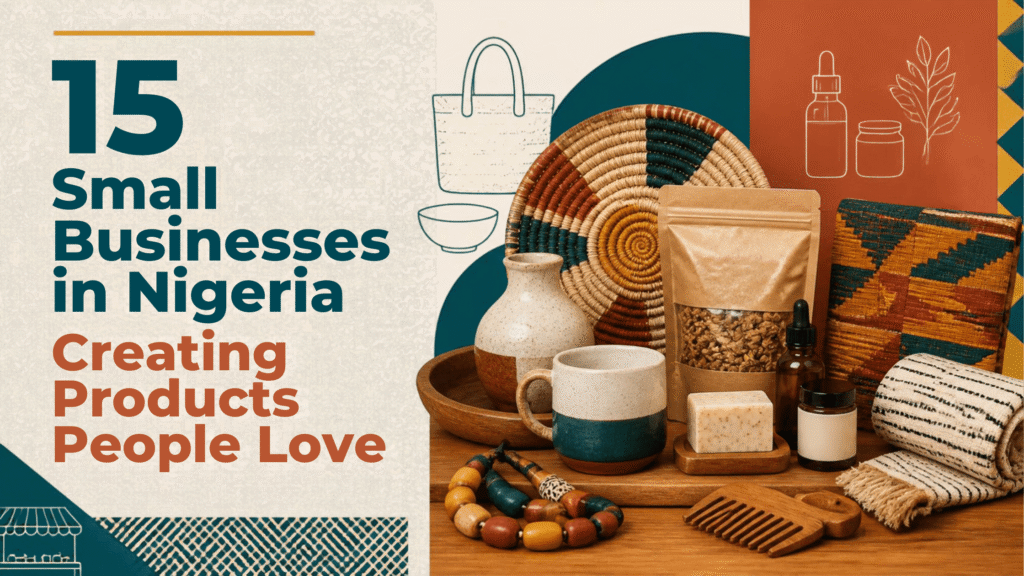
Some of Nigeria’s most interesting products are not coming from companies with enormous factories, celebrity ambassadors or shelves in every major supermarket.
They are coming from kitchens, workshops, small production spaces and home studios.
A woman notices that people are struggling to prepare food after work and develops a range of cooking bases. A young designer starts making jewellery inspired by Nigerian heritage. A pharmacy graduate begins blending fragrances. A shoemaker decides that locally made footwear should look and feel premium.
These businesses may be small, but the thinking behind them is not.
Nigeria has a huge and diverse small-business ecosystem, spanning food processing, fashion, beauty, jewellery, footwear, home products and manufacturing. Recent programmes from SMEDAN and the National Centre for Brands Development have also highlighted the breadth of locally made products being developed by Nigerian entrepreneurs.
Here are 15 Nigerian small businesses creating products that deserve more attention.
1. Àjàrà Foods
Àjàrà Foods began with a very Nigerian problem: cooking is enjoyable, but the preparation can be exhausting.
Founded by Dolapo Daramola in January 2025, the business started in her kitchen with three products designed to make everyday Nigerian cooking easier. Its range includes prepared cooking bases, pepper mixes, chilli dips and palm-oil products.
The idea came partly from watching her children choose to order food rather than spend hours preparing ingredients.
Less than a year after starting, Àjàrà had expanded to six products, its own production space, NAFDAC certification for four products, an all-women production team and customers in the UK and Canada. The business has also appeared at the GTCO Food and Drink Festival.
There is something particularly compelling about the proposition: it does not try to change what Nigerians eat. It simply makes the process of preparing it easier.
That is often where good products begin — with an ordinary frustration that someone decides to solve.
2. BERA Tomato
BERA Tomato was born from something Adaora Akojuru saw while working as a journalist.
During a visit to a farming community in Kano State, she saw large quantities of tomatoes being left to rot because farmers could not find enough buyers. The experience eventually led her to establish Beta Agric Ventures and develop BERA Tomato, a tomato paste made from farm-fresh tomatoes.
The business began in a small BQ apartment with one farmer supplying raw materials.
It has since grown into a larger processing operation connected to more than 500 farmers, while working on additional farmer inclusion initiatives.
The product therefore represents more than another tomato paste on a shelf. It connects food manufacturing with the farmers supplying the raw material and addresses the problem that first inspired the business: post-harvest loss.
It is a useful example of how a Nigerian product can sit at the intersection of commerce and a much larger agricultural problem.
3. Otasansan
Otasansan is built around something Nigerians understand particularly well: the need for food to have the right amount of flavour.
Ayomide Logo created the brand after repeatedly seeing Nigerians living away from home talk about missing the flavours they grew up with.
The result is a Nigerian-style chilli oil that can be used with rice, noodles, eggs, meat, plantain and other meals. The brand even developed a smaller 50ml version for travellers and people who want to carry the product around easily.
What makes Otasansan interesting is its simplicity.
It is not trying to reinvent Nigerian food. It is taking a familiar flavour and turning it into a convenient packaged product that can travel.
That creates possibilities well beyond the Nigerian kitchen.
4. Signature Snacks Global
Healthy snacking is a growing opportunity, but making nutritious food that people actually want to eat is another matter.
Signature Snacks Global was started by Christina Akinrinde in 2022 after she noticed a gap between the demand for snacks and the availability of convenient options with a stronger nutritional focus.
The business has grown alongside a wider network. According to SMEDAN, more than 80 percent of its workforce is women, it has direct off-take relationships with farmers and more than 130 young people have received training through the business.
That makes the company interesting beyond the snacks themselves.
It shows how a small Nigerian product company can build a supply chain and skills ecosystem around what it sells.
5. Fragrant Flair
Fragrance is one of those product categories where a small brand can create a remarkably personal relationship with its customers.
Khadija Abba Kyari launched Fragrant Flair in Borno State in 2023 while studying pharmacy. The brand produces perfumes, perfume oils, body milk, scented beads, reed diffusers and customised souvenir packages.
The business grew partly through listening to customers.
People initially bought the fragrances, then began asking for other scent-related products. The brand responded by expanding its range.
That customer-led approach is one reason Fragrant Flair stands out.
It is building a product business around something intangible, the way a particular scent makes someone feel and how strongly a fragrance can become part of someone’s identity.
6. Glanelo Luxury
There is a persistent perception that premium leather products have to be imported.
Glanelo Luxury is part of the group of Nigerian businesses challenging that assumption.
Founded by Chioma in 2023 and based in Agbara, Ogun State, the company produces handcrafted leather footwear for customers across Nigeria. It began under another name before rebranding to Glanelo Luxury as the founder became more intentional about building a recognisable brand.
One of the most revealing parts of the story is that customers began returning after experiencing the quality of the products.
That is important for a small manufacturing business.
A good-looking Instagram page may attract the first customer. Consistency and quality are what can bring the second order.
Glanelo’s story is ultimately about turning craftsmanship into a brand.
7. LUVV by Bella
LUVV by Bella brings together contemporary jewellery and Nigerian cultural references.
The brand was developed by Bella Alubo, who drew inspiration from her mother’s bead-making background and from the traditional jewellery seen in old Nigerian photographs.
Bella began developing the concept around the end of 2021 and launched the brand in 2022. The business has since grown from selling a few pieces a month to hundreds, with a functioning international e-commerce operation and stockists. Its jewellery has also been worn by Nigerian musicians and at major entertainment events.
What makes LUVV interesting is its positioning.
It does not simply reproduce traditional Nigerian jewellery. It interprets African references for a younger, contemporary audience.
That is an increasingly important opportunity for Nigerian product businesses: taking something culturally familiar and making it feel relevant to a new generation.
8. Myria Gee
Myria Gee represents the manufacturing side of Nigeria’s growing cosmetics industry.
Founded by Pearl Ubani, the company operates a cosmetics manufacturing facility in Kuje, Abuja, where products including lipsticks, foundations and other cosmetics are formulated, tested and manufactured locally.
That distinction matters.
Nigeria has no shortage of beauty brands, but the ability to actually formulate and manufacture products locally creates a different kind of opportunity.
It means businesses can potentially develop products around the needs of their market while building local technical and manufacturing capacity.
Myria Gee is therefore interesting not just as a cosmetics company, but as part of a broader movement toward Nigerian-owned beauty manufacturing.
9. Sparklean Station
Sparklean Station started with a personal experience and developed into a cleaning-products manufacturing business.
Ameedah Olaniyan began researching disinfectants after a serious illness in her family exposed her to the difference between simply cleaning a space and disinfecting it.
What started with experimentation in a room eventually became Sparklean Station Nigeria Limited.
According to SMEDAN, the company now operates a factory in Ilorin and exports products to Niamey in Niger Republic, including white-label manufacturing for an international reseller.
The journey is a reminder that manufacturing businesses do not necessarily start with large facilities.
Sometimes they start with someone asking a question and refusing to stop at the first answer.
10. TimiJay’s Endroit
TimiJay’s Endroit began with ₦10,000 and a simple idea: Ankara could be much more than traditional occasion wear.
Oguntosin Jolomi, known as TimiJay, started exploring African prints in 2020. What began as selling fabric eventually evolved into ready-to-wear fashion, with the brand later expanding into menswear.
The business reportedly served more than 800 women within its first few years.
That growth is notable because the original proposition was not particularly complicated.
The founder saw a familiar fabric and imagined a different way of wearing it.
Small businesses often create their strongest products this way — not by inventing an entirely new category, but by seeing a familiar category differently.
11. 3Sevens Creative Global
3Sevens Creative Global is a bridal and fashion business based in Ilorin, Kwara State.
Todimu Okeowo had spent nine years in public service while continuing to design and sew. The business began after she made corporate outfits for a banker whose colleagues subsequently requested their own pieces.
Those referrals eventually became the foundation for the business, which was formally established in 2017.
The story is a useful reminder of how important word-of-mouth remains for Nigerian small businesses.
There was no massive launch campaign behind the first customers.
The work itself created the next opportunity.
That kind of organic growth is still one of the strongest forms of validation a product-based business can receive.
12. Hannadex Design World
Hannadex Design World brings crochet and handmade craft into the contemporary Nigerian fashion conversation.
Founded by Hannah Okeya, the business grew from a personal creative journey into a fashion enterprise. SMEDAN’s 2026 profile describes how Hannah began creating crochet pieces from a corner of her sitting room before building the business further.
The appeal of businesses like Hannadex is partly in their individuality.
Mass production can make products accessible, but handmade businesses offer something different: pieces with a visible human touch.
For Nigerian designers and craft entrepreneurs, that distinction can become a powerful part of the brand.
13. Redbubble Naturals
Redbubble Naturals is another example of a Nigerian small business built around locally connected ingredients and wellness products.
The company was founded by Anne Olawunmi after a family health experience prompted her to research natural products and develop a business around what she learned. SMEDAN profiled the company in 2026 as part of its Made in Nigeria small-business series.
The broader significance of businesses like Redbubble Naturals is the growing space between traditional knowledge and modern consumer products.
There is considerable room for Nigerian companies to take familiar plants, ingredients and wellness practices and develop them into properly packaged, branded and responsibly produced products.
For this category, however, evidence-based product claims and regulatory compliance are especially important.
14. LUVV by Bella
Editorial correction: LUVV by Bella has already appeared at number 7, so it should not be repeated.
A stronger replacement is BERA Tomato, but that has also already appeared at number 2.
For the final publication, this entry should instead be:
14. Glanelo Luxury
Editorial correction: Glanelo Luxury has already appeared at number 6.
The clean final version should contain unique businesses only.
14. A wider ecosystem of makers
One of the most interesting things happening around Nigerian small businesses is the emergence of marketplaces that make it easier to discover them.
Good.online, for example, currently features Nigerian creators selling products across food, fashion, beauty, home and gifts. Its current marketplace includes businesses such as Chumbys, Dala Craft, Infused Organics, Garmisland, Jacqué Lagos and Smileys Africa.
That matters because discoverability is often one of the biggest challenges facing small Nigerian product businesses.
A great product cannot be bought if customers never hear about it.
15. Nigerian small businesses beyond the obvious names
The same story is playing out across the country.
SMEDAN’s 2026 programmes and profiles have highlighted businesses working in food processing, fashion, cosmetics, fragrance, footwear, cleaning products, agriculture and craft. Its current MSME ecosystem includes businesses from different parts of Nigeria rather than only the country’s largest commercial centres.
The National Centre for Brands Development and Made in Nigeria Project Office similarly identifies a broad range of locally made products across food, fashion, technology, furniture, home décor, health and beauty.
That is perhaps the most important story here.
There is no single “Nigerian small business.”
There are thousands of them solving different problems for different customers.
Why These Businesses Matter
The businesses on this list operate in very different industries, but several patterns connect them.
They start with real problems
Àjàrà Foods came from the frustration of food preparation.
BERA Tomato came from seeing farmers lose their harvest.
Otasansan came from people missing familiar Nigerian flavours.
Sparklean Station came from a family experience that exposed a need for better disinfection products.
The product came after the problem.
That is a useful distinction between simply making something and building something people actually want.
They make familiar things differently
Ankara becomes modern everyday fashion.
Traditional jewellery becomes neo-African jewellery.
Local tomatoes become a packaged consumer product.
Familiar scents become branded fragrance collections.
African ingredients become contemporary beauty and wellness products.
This is one of the most interesting parts of Nigeria’s product economy: innovation does not always mean inventing something nobody has seen before.
Sometimes it means taking something people already know and making them see it differently.
They prove that small does not mean insignificant
A business can begin in a kitchen, a sitting room, a BQ apartment or a small workshop and still develop into something much larger.
The businesses highlighted by SMEDAN in 2026 show this range clearly, from entrepreneurs producing products from home-based beginnings to companies that have moved into dedicated manufacturing spaces and export markets.
The distance between “small business” and “big brand” is not always as large as it appears.
Sometimes the biggest difference is distribution.
Nigeria’s next big brands may already be small
The Nigerian consumer market is large enough to create opportunities for thousands of specialised brands.
But building a product is only one part of the journey.
These businesses still have to solve familiar problems: access to capital, manufacturing capacity, electricity, logistics, packaging, regulation, distribution and visibility.
And visibility may be one of the biggest of them all.
Good.online’s emergence as a curated marketplace for Nigerian creators reflects a simple reality: many Nigerian makers are already creating good products, but customers do not always know where to find them.
The Bigger Story
Nigeria’s product economy is often discussed through the biggest names, the companies with nationwide distribution, huge workforces and familiar advertising campaigns.
But that is only one part of the picture.
There is another Nigeria being built in smaller workshops, kitchens, studios and production spaces.
It is the Nigeria making chilli oil, tomato paste, jewellery, shoes, fragrances, snacks, cosmetics, fashion and cleaning products.
Some of these businesses will remain small and specialised.
Others will eventually become household names.
What they have in common today is that someone saw an opportunity, made something, put it in front of a customer and kept improving it.
That is how many of Nigeria’s next great brands will begin.
Not with a giant factory.
With one good product.
