Best Inventory and Sales Apps for Nigerian Shop Owners
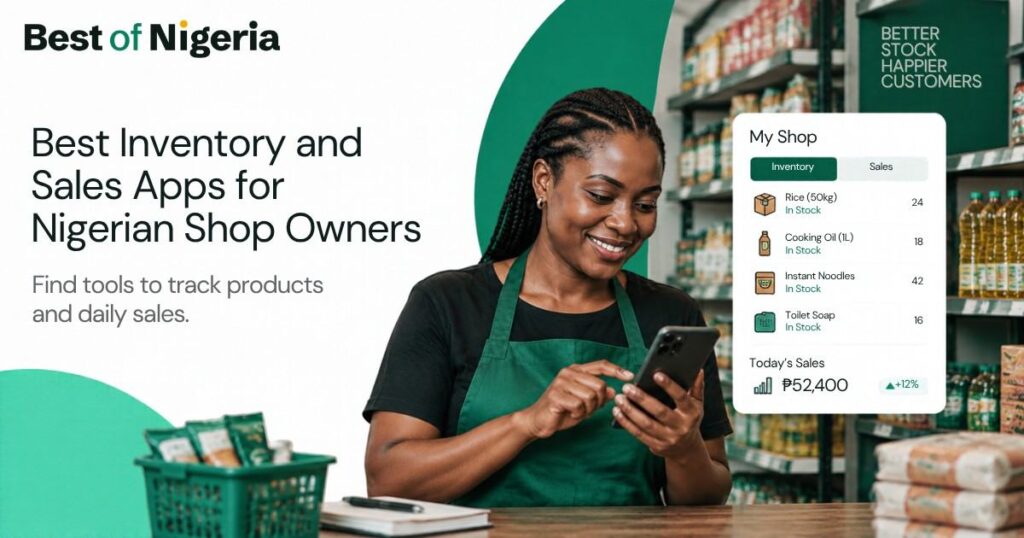
Running a shop in Nigeria involves more than buying products and selling them to customers. You have to keep track of stock, monitor daily sales, manage expenses, remember customers who buy on credit, deal with suppliers and know when it is time to restock.
For many small business owners, these activities are still managed with exercise books, calculators, spreadsheets and sometimes WhatsApp messages. While these methods might work when a business is small, they can become difficult to manage as sales increase, more products are added and employees become involved in daily operations.
This is where inventory and sales management apps come in.
With the right business management app, shop owners can record transactions, monitor stock levels, track business performance and manage important operations from their smartphones or computers.
Fortunately, there are Nigerian-built solutions designed to address these challenges. Rather than focusing entirely on international software, this guide highlights apps developed by Nigerian businesses and product teams, with features relevant to the realities of running a shop in Nigeria.
Here are some inventory and sales apps Nigerian shop owners should know about.
1. Bumpa
Best for: Retailers, fashion businesses and online sellers
Bumpa is one of the Nigerian-built business management platforms designed to help entrepreneurs manage different aspects of their businesses from one place.
Developed by Lagos-based Salescabal, Bumpa was founded in 2021 by Kelvin Umechukwu and Adetunji Opayele. The platform combines inventory management, sales tracking, order management and online commerce features.
One of its biggest advantages is that business owners can manage both physical and online sales without necessarily maintaining separate records.
With Bumpa, shop owners can:
- Add products and manage inventory.
- Record sales and monitor orders.
- Generate invoices and receipts.
- Create an online store without coding.
- Monitor business performance through analytics.
- Maintain customer records and transaction histories.
- Manage orders coming from different sales channels.
Bumpa is particularly useful for fashion retailers, beauty businesses, electronics sellers and entrepreneurs who sell through Instagram, WhatsApp and their own websites.
For a business that wants to move beyond physical shop sales and establish a stronger online presence, Bumpa is worth considering.
Website: https://www.getbumpa.com/
2. Timart Business App
Best for: Supermarkets, provision stores, pharmacies and retail shops
Timart is a Nigerian business management solution developed by Timart Business Solutions Ltd. It focuses on helping retailers manage inventory, sales, staff and other daily business activities.
The platform is designed for businesses that need more than a simple sales-recording application.
Its inventory management features help shop owners monitor available products, while its sales and reporting tools provide better visibility into how the business is performing.
Some of its key features include:
- Inventory and stock management.
- Sales and profit tracking.
- Customer debt management.
- Income and expense tracking.
- Invoice and receipt generation.
- Supplier and purchase order management.
- Multiple branch management.
- Staff accounts and management.
- Business performance reports.
Another useful feature is its support for mobile, desktop and web access, alongside offline operation with synchronisation when connectivity returns.
Timart can be particularly useful for supermarket operators, pharmacy owners, restaurant businesses, provision stores and retailers managing multiple employees.
If you want to monitor what your employees sell, keep track of stock and understand your business performance without relying entirely on manual records, it is worth exploring.
Website: https://www.gettimart.com/
3. Oja POS
Best for: Small shops, market traders and everyday retailers
Oja POS is a Nigerian-built point-of-sale and business management application designed around the everyday needs of shop owners.
Its approach is relatively straightforward: make it easier for retailers to record transactions, manage products and keep track of their businesses without needing complicated software or expensive infrastructure.
The platform supports offline selling, which is particularly relevant for Nigerian businesses that sometimes experience unreliable internet connections.
Its features include:
- Recording sales and transactions.
- Adding products and managing prices.
- Barcode scanning.
- Tracking stock.
- Sending receipts through WhatsApp.
- Creating a WhatsApp storefront.
- Supporting receipt printers.
- Operating without an active internet connection.
Oja POS is particularly interesting for small retailers who want to move away from paper-based sales records but do not necessarily need a complex business management system.
Its offline-first approach also makes it worth considering for shops where internet connectivity cannot always be guaranteed.
Website: https://ojapos.app/
4. Veridus
Best for: Provision stores, neighbourhood shops and small retailers
Veridus is another inventory and sales management solution targeting Nigerian retailers.
The platform focuses on helping business owners understand what is happening inside their shops, particularly around stock movement, sales, customer debts and profitability.
Instead of simply recording how much money comes into the business, Veridus aims to give shop owners a clearer picture of their daily operations.
Its features include:
- Recording sales through a digital point-of-sale interface.
- Monitoring inventory and available stock.
- Tracking customer debts and outstanding balances.
- Recording payments through cash, bank transfer, POS and credit.
- Monitoring sales, costs and profits.
- Viewing business performance reports.
One particularly useful aspect is its customer debt management functionality.
In many Nigerian neighbourhood shops, customers regularly buy products and promise to pay later. Without proper records, these transactions can become difficult to monitor.
Veridus provides a digital way to record what customers owe and track outstanding balances.
For small retailers who want to understand their actual profits and reduce losses associated with poor record-keeping, Veridus is worth exploring.
Website: https://www.veriduspro.com/
5. Tabs
Best for: Specialised retail businesses and shops with multiple branches
Tabs is an inventory and sales management platform designed for Nigerian retail businesses.
One thing that makes it interesting is its focus on the different inventory requirements of different types of shops.
For example, a fashion retailer needs to track clothing sizes and colours, while a pharmacy needs to monitor product batches and expiry dates. A phone shop may need to track different models, storage capacities and device conditions.
Tabs addresses these differences by providing industry-specific inventory management features.
Depending on the type of business, its features include:
- Product and inventory management.
- Sales and order tracking.
- Supplier management.
- Multiple store and branch management.
- Staff management.
- Barcode scanning.
- Product variants such as sizes and colours.
- Pharmacy batch and expiry tracking.
- Stock transfers between locations.
Tabs could be particularly useful for established retailers who have more complicated inventory requirements than a typical neighbourhood shop.
For businesses with multiple branches, having a centralised system for monitoring stock and sales can make it easier to understand what is happening across different locations.
Website: https://www.usetabs.app/
How to Choose the Right Inventory and Sales App for Your Business
Not every shop needs the same type of software. A small provision store with one employee has different requirements from a supermarket with several branches and hundreds of products.
Before choosing an application, consider the following factors.
1. Inventory Management
The application should allow you to know how many products you have available, how many have been sold and when it is time to restock.
Look for features such as automatic stock deductions after sales, low-stock alerts and stock adjustment records.
2. Sales Tracking
You should be able to record every transaction and know how much your business sells daily, weekly and monthly.
A good application should also allow you to distinguish between cash, bank transfers, POS payments and credit transactions.
3. Profit and Expense Tracking
Making sales does not necessarily mean your business is profitable.
Your application should help you monitor the cost of purchasing products, business expenses and the difference between revenue and costs.
4. Customer and Debt Management
If you allow customers to buy on credit, you need a reliable way to record their purchases, payments and outstanding balances.
This is especially important for neighbourhood retailers, wholesalers and businesses that regularly sell to returning customers.
5. Offline Functionality
Internet connectivity can be unreliable in some parts of Nigeria.
An application that allows you to continue recording sales offline and synchronises your information when you reconnect can be a significant advantage.
6. Staff and Multiple Branch Management
If you employ sales assistants or operate more than one shop, consider an application that allows you to create individual staff accounts and monitor transactions.
You should be able to understand who recorded each sale and, where necessary, restrict what different employees can access.
7. Pricing and Ease of Use
Finally, consider the subscription cost and whether the application is easy for you and your employees to use.
Some platforms offer free entry-level plans, while others operate through subscriptions or paid packages.
Before committing, confirm the current pricing, transaction charges, available features and any hardware requirements directly with the provider.
Why Nigerian Shop Owners Should Consider Locally Built Business Apps
International inventory and sales applications can offer excellent features, but they are not always designed around the everyday realities of Nigerian retail businesses.
Locally developed platforms have an opportunity to understand these challenges more closely.
For example, Nigerian retailers need to account for bank transfers, POS transactions, customers who buy on credit, unstable internet connections, different supplier arrangements and the practical realities of managing small shops.
They also need software that is affordable, accessible and simple enough for employees to learn without extensive training.
Nigerian-built applications can help address these requirements while supporting the growth of the country’s local technology ecosystem.
However, being locally developed should not be the only reason to choose an application. Business owners should still evaluate its reliability, security, customer support, functionality and long-term sustainability.
Final Thoughts
Managing a retail business with notebooks and manual calculations can become increasingly difficult as the business grows.
Inventory and sales management apps provide an opportunity to improve record-keeping, reduce avoidable losses, monitor stock and make better business decisions.
Platforms such as Bumpa, Timart, Oja POS, Veridus and Tabs offer different approaches to solving these problems.
The best choice ultimately depends on the nature of your business. A fashion retailer looking to combine online and offline sales may find Bumpa useful, while a supermarket or pharmacy may prefer a solution with more specialised inventory and staff management features.
Before making a decision, explore the available platforms, test their features and choose one that fits how your business actually operates.
The goal is not simply to start using technology. It is to have better control over your stock, sales, money and the overall performance of your business.

Best of Nigeria Editorial Team
The Best of Nigeria Editorial Team shares stories, insights, guides, and features celebrating Nigeria’s people, businesses, culture, destinations, and opportunities. Through informative articles and carefully curated content, we help readers discover the people, ideas, and organisations shaping Nigeria’s story.