10 Best Places to Experience Nature in Nigeria
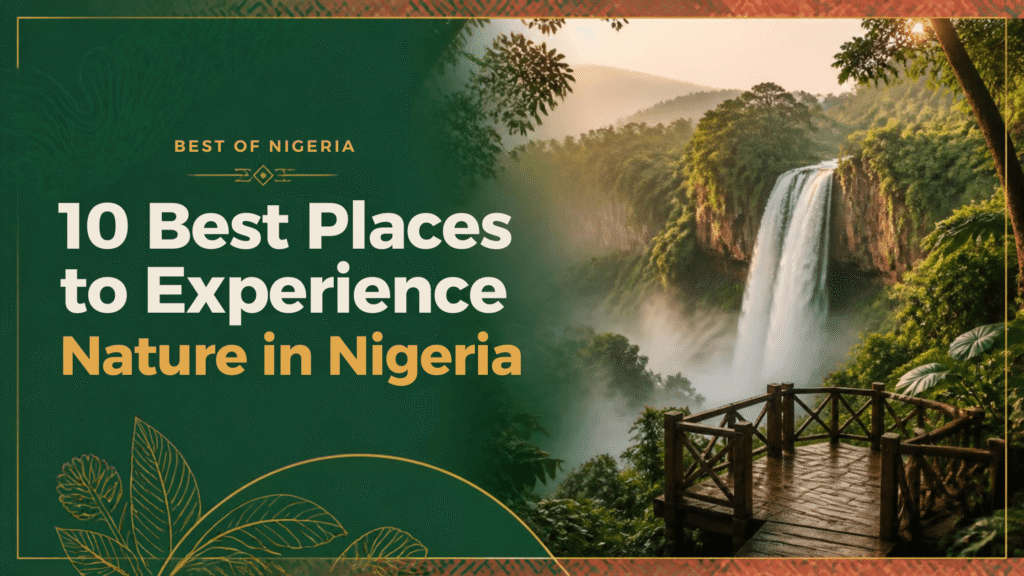
Nigeria is often introduced through its cities, food, music and business culture. But beyond Lagos, Abuja and the country’s major urban centres is a very different Nigeria: mountains rising above forests, waterfalls cutting through rock, tropical rainforests filled with wildlife, warm springs, savannah landscapes and enormous wetlands.
From the forests of Cross River to the mountains of Taraba and the waterfalls of Osun, Nigeria offers plenty of ways to experience the outdoors without leaving the country.
Here are 10 places worth putting on your nature-travel list.
1. Gashaka-Gumti National Park, Taraba and Adamawa
For a serious wilderness experience, Gashaka-Gumti is difficult to overlook.
Covering about 5,907 square kilometres, it is Nigeria’s largest national park and one of the largest protected areas in West Africa. Its landscape stretches from lowland areas into rugged highlands, with montane forests, grasslands, gallery forests and savannah ecosystems.
The park is particularly interesting for travellers who want more than a conventional sightseeing trip. Its rugged terrain and remote character create opportunities for hiking, wildlife observation, birdwatching and exploring some of Nigeria’s most dramatic mountain scenery.
Gashaka-Gumti is also on Nigeria’s UNESCO World Heritage Tentative List. UNESCO describes the park as an important protected landscape with significant biodiversity, including species such as chimpanzees, African golden cats, giant pangolins and leopards.
Why go
- Mountain and forest landscapes
- Wildlife and birdwatching
- Long-distance hiking and wilderness exploration
- One of Nigeria’s most extensive protected natural areas
Best for: Adventure travellers, hikers, wildlife enthusiasts and serious nature lovers.
2. Cross River National Park, Cross River State
Cross River National Park takes you into one of the most important rainforest landscapes in Nigeria.
The park covers about 4,000 square kilometres and contains extensive tropical rainforest, as well as montane vegetation around the Obudu Plateau. It is divided into the Oban and Okwangwo sectors.
Its biodiversity is one of its major attractions. The Okwangwo area, for example, contains the Cross River gorilla, one of the world’s rarest gorilla subspecies, alongside numerous other plant and animal species.
The wider Cross River–Korup–Takamanda landscape has also been recognised by UNESCO as a region of exceptional biodiversity and is on the World Heritage Tentative List.
This is the kind of destination where the forest itself is the attraction. You are not simply visiting a single monument or viewpoint; you are entering a major ecological landscape.
Why go
- Dense tropical rainforest
- Wildlife and birdwatching
- Mountain and forest scenery
- Exceptional biodiversity
- Opportunities for ecotourism
Best for: Wildlife enthusiasts, photographers, hikers and travellers interested in rainforest ecosystems.
3. Obudu Mountains, Cross River State
The Obudu area offers one of Nigeria’s most recognisable mountain landscapes.
The terrain around Obudu combines highlands, rolling green hills, forests, rivers and dramatic viewpoints. The local government highlights destinations including Kabor-Ungwa Mountain, Ulanga Mountain, Ukpada River and other natural landscapes around the area.
The famous Obudu Ranch Resort sits within this mountain environment and has long been associated with Nigeria’s highland tourism.
The destination is currently undergoing a major repositioning. In 2026, the Cross River State Government said the Obudu Ranch Resort concession would support rehabilitation and modernisation, including restoration of the iconic cable car, accommodation and recreational facilities.
That makes Obudu particularly interesting for travellers who want scenery without giving up access to established hospitality infrastructure.
Why go
- Mountain views
- Green highland landscapes
- Hiking and outdoor activities
- Rivers and natural features
- Access to the wider Cross River tourism circuit
Best for: Mountain escapes, couples, families, photographers and weekend travellers looking for dramatic scenery.
4. Okomu National Park, Edo State
Okomu offers a different kind of Nigerian nature experience: rainforest wildlife within relatively easy reach of Benin City.
According to the Nigeria National Park Service, Okomu National Park covers about 202 square kilometres and is home to a variety of wildlife, including forest elephants, forest buffalo, pygmy hippopotamus, red river hog, duikers, monkeys and more than 200 recorded bird species.
The park also has facilities including accommodation at Arakhuan Base Camp, a tree house, aerial walkway and hanging bridge. The National Park Service says the park is open year-round, although road conditions can become more difficult during the rainy season.
For visitors coming from southern Nigeria, Okomu can therefore offer a relatively practical introduction to Nigeria’s rainforest environment.
Why go
- Rainforest wildlife
- Birdwatching
- Forest trails
- Tree-house and aerial-walkway experiences
- Relatively accessible from Benin City
Best for: First-time wildlife travellers, birdwatchers and families seeking an outdoor adventure.
5. Erin-Ijesa (Olumirin) Waterfalls, Osun State
Some Nigerian natural attractions make you work for the view. Erin-Ijesa is one of them.
Also known as Olumirin Waterfalls, the attraction is located in Erin-Ijesa in Osun State. The waterfall moves through a forested landscape in a series of cascades, with the climb becoming more demanding as visitors move towards the upper levels.
The experience is as much about the journey as the waterfall itself: forest, rocks, water, changing elevations and views over the surrounding landscape.
The Osun State Government has also announced plans to develop the waterfall through a public-private partnership as part of a wider tourism programme.
Conditions can change with rainfall, so visitors should check current access and weather conditions and wear footwear suitable for wet and uneven terrain.
Why go
- Multi-level waterfall
- Forest hiking
- Natural pools and cascades
- Scenic views
- Strong connection to the surrounding Erin-Ijesa community
Best for: Hikers, photographers, adventure seekers and anyone looking for a day trip centred around water and forest.
6. Ikogosi Warm Springs, Ekiti State
Nature does not always have to mean climbing a mountain or searching for wildlife.
At Ikogosi, the attraction is the unusual meeting of warm and cold springs.
The Ekiti State Government describes the site as a place where warm and cold water emerge separately before flowing together while retaining their different thermal characteristics. The springs sit within a green, hilly landscape in Ikogosi-Ekiti.
The destination has also undergone redevelopment through public-private partnership. Ekiti’s investment agency describes the Ikogosi Warm Spring as a revitalised ecotourism destination, while the current resort offers accommodation and nature-oriented activities including hiking and camping.
It is one of those places where the natural phenomenon is simple to understand but fascinating to experience in person.
Why go
- Warm and cold springs
- Forested surroundings
- Hills and walking trails
- Relaxation and outdoor activities
- Resort accommodation
Best for: Relaxing getaways, couples, families and travellers who prefer gentle nature experiences.
7. Oke Idanre, Ondo State
Oke Idanre combines mountains, forests and history in one landscape.
The Idanre Hills rise dramatically above the surrounding area, with valleys, rock formations, vegetation and historic features spread across the landscape. UNESCO’s description notes that the hills contain diverse ecosystems of flora and fauna alongside cultural features including old settlements, shrines, the Old Court and other historic structures.
The site is on Nigeria’s UNESCO World Heritage Tentative List.
Oke Idanre is particularly interesting because the natural landscape cannot easily be separated from the human story. The hills once formed the centre of the Idanre settlement, and the relationship between the community, the rocks, vegetation and surrounding environment remains part of the attraction.
Why go
- Dramatic hills and rock formations
- Hiking and viewpoints
- Forest and wildlife
- Historic settlement
- Cultural landscape
Best for: Hikers, photographers, history lovers and travellers who want nature with a strong cultural dimension.
8. Osun-Osogbo Sacred Grove, Osun State
Nature and culture meet particularly strongly at the Osun-Osogbo Sacred Grove.
Located on the outskirts of Osogbo, the grove contains dense forest, the Osun River, shrines, sculptures and artworks. UNESCO describes it as one of the last remnants of primary high forest in southern Nigeria and the largest surviving sacred grove in Yorubaland.
Unlike a conventional nature reserve, this is a living cultural landscape. The forest has spiritual significance and remains connected to Yoruba religious traditions and the annual Osun-Osogbo Festival.
It is also one of only two Nigerian properties currently inscribed on UNESCO’s World Heritage List.
For visitors, the experience is less about ticking off wildlife sightings and more about walking through a landscape where forest, river, art, spirituality and history exist together.
Why go
- Dense forest
- River landscape
- Sculptures and shrines
- Yoruba cultural heritage
- UNESCO World Heritage status
Best for: Culture lovers, photographers, heritage travellers and anyone interested in sacred landscapes.
9. Kainji Lake National Park, Niger and Kwara States
Kainji Lake National Park offers a large-scale savannah and wildlife experience in north-central Nigeria.
The park covers more than 5,300 square kilometres across two sectors, Borgu and Zugurma. Its landscape includes rolling hills, valleys, rivers, woodland savannah and riparian forests.
The Nigeria National Park Service lists wildlife including hippopotamus, roan antelope, kob, hartebeest, buffalo, hyena, baboon and other species. Visitors can also participate in wilderness treks, game viewing, birdwatching, wildlife tracking and water recreation.
The scale of the landscape makes Kainji different from the forest and waterfall destinations further south.
Why go
- Savannah landscapes
- Wildlife viewing
- Birdwatching
- Wilderness trekking
- Rivers and water recreation
- Large protected landscape
Best for: Safari-style experiences, wildlife enthusiasts and travellers interested in northern Nigerian landscapes.
10. Niger Delta Mangroves, Southern Nigeria
For a completely different view of Nigerian nature, head towards the wetlands of the Niger Delta.
The Niger Delta is surrounded by extensive mangrove forests that protect large areas of freshwater swamp. UNESCO notes that the trees and complex root systems provide habitats for a wide variety of flora and fauna. The Niger Delta Mangroves are also on Nigeria’s UNESCO World Heritage Tentative List as a natural site.
This is not the kind of destination that should be approached like a conventional resort. The landscape is defined by waterways, wetlands, mangrove forests and communities whose lives are closely connected to the environment.
For travellers interested in ecology, photography, fishing communities, waterways and coastal landscapes, the Delta offers a side of Nigeria that is very different from the country’s better-known mountains and waterfalls.
Why go
- Mangrove forests
- Wetlands and waterways
- Bird and wildlife observation
- Unique coastal ecosystems
- Community and environmental tourism
Best for: Eco-travellers, photographers, researchers and travellers interested in wetlands and coastal ecosystems.
Nigeria’s Natural Beauty Goes Far Beyond the Famous Tourist Spots
One of the most interesting things about experiencing nature in Nigeria is the sheer variety of landscapes.
You can move from the rainforest of Cross River to the mountains of Obudu, from the savannah of Kainji to the waterfalls of Osun, and from the warm springs of Ekiti to the mangrove wetlands of the Niger Delta.
And these are only some of the country’s natural landscapes.
Nigeria currently has 13 sites on UNESCO’s World Heritage Tentative List, including Gashaka-Gumti National Park, the Cross River–Korup–Takamanda national parks, Oke Idanre and the Niger Delta Mangroves.
The bigger opportunity is not simply to visit these places. It is to experience them responsibly.
That means respecting local communities, following site rules, avoiding littering, using local guides where appropriate, protecting wildlife and vegetation, and checking current access and weather conditions before travelling.
The next time you are planning a Nigerian getaway, you do not necessarily need another city break.
Sometimes, the better trip starts where the road ends and the forest begins.
